Saturday, January 14, 2006

In The Presence of Giants (and Midgets)

Last night at the annual conference of the International Alliance of Jazz Educators, the National Endowment for the Arts (NEA) announced its '06 class of NEA Jazz Masters. Among those honored included the likes of Tony Bennett and Chick Corea.

At the end of the evening, conductors of the two big bands that provided most of the evening's entertainment invited any NEA Jazz Master in the audience to come up on stage and play along. While hearing legends like Latin jazz king Paquito D'Rivera was a real treat and the level of excellence and creativity borne from decades of practice and performance was obvious, I thought that a 10-year old trumpet player that snuck up on stage and was given a shot at the mic stole the show. Not only did he play great but it was clear that he would have been happy to play all night long ... one of the bandleaders literally took the instrument out of his hands to give the rest of the masters some minutes!

As the two bands played with a host of masters (there were probably 40+ musicians on stage by the end of the night), I turned to Marty Ashby, Executive Producer of MCG Jazz (an Accelerator venture), and pointed out how the actions on stage represented much of what companies around the world will need more of the in the future -- creativity, improvisation, teamwork, individual mastery, respected leadership, joy, passion, enthusiasm ...

Hmm, now if you could just bottle that up and get it out to the masses ...

Thursday, January 12, 2006

Legends and Luminaries


What do Nancy Wilson, Tom Scott, Clark Terry, Doc Severinsen, and Dr. Billy Taylor have in common? Besides being among a select group of living jazz legends, all were in attendance at the opening gala for the International Alliance of Jazz Educator’s annual conference, this year held in Midtown Manhattan. Why was I (can't sing, can't dance, can't play an instrument) there? As a guest of MCG Jazz, one of the leading ventures in the Accelerator's portfolio and, as a division of the acclaimed Manchester Craftsmen's Guild and Bidwell Training Center, a globally recognized social enterprise supporting youth education and adult workforce training programs with its mix of jazz concerts and album releases.

MCG Jazz, along with IAJE through its independent subsidiary Jazz Alliance International and a host of "mavens, connectors, and salesmen" (to use Tipping Point terminology) in the industry, are leading the charge to build awareness and market share for jazz while creating a sustainable business model that fulfills both social impact objectives and $$$ requirements in the long-term. The questions being confronted by the jazz industry are similar to, say, NASCAR more than a few years ago: How do we tap into an existing and rabid community of fanatics to create a bigger revenue "pie" while not ruining what attracted fans to the sport in the first place? How can we best introduce the "product" to people not familiar with the concept or who have preconceived notions about it so that a new generation of fanatics will emerge? How do we prioritize our options and opportunities in light of (at least initially) limited resources? Who are the key players to enlist in both the strategy and tactics to harness such a substantial amount of latent potential?

The artists, industry insiders, and other attendees of last night's gala couldn't have been more visibly dedicated to the music, the personalities that shaped it, or to perpetuating the genre for generations to come. All of that passion and ability to improvise will come in handy as the very entrepreneurial work of reshaping the business side of jazz unfolds in the months ahead.

Sunday, January 08, 2006

Red Roads and White Roads

Sometimes getting sick can be a blessing in disguise. After being surrounded by the ill and infirmed throughout the holidays, it finally caught up with me at the start of the new year in the form of a mostly irritating (as opposed to debilitating) head cold. Taking it as an early test of my intent to slow down and do fewer things better, I stayed in bed (instead of trying, literally, to work through it) and attacked the rising stack of books beside my bed.

One book that I'd been dying to get through for a while was

Raising the Bar by Clif Bar founder Gary Erickson. As a cycling and outdoor sports fanatic, I've tried just about every bar and supplement on the market and I'm an unabashed Clif Bar loyalist. But there's always been some elusive "something else" that has always connected me to the product and, by extension, to the company. An authenticity, a simplicity, an engaging Horatio Alger story perhaps ... "something else".

The book helped to clear up the "something else" by using a map metaphor of "red roads" and "white roads" to describe the company's distinctiveness. A company on the red road:

"... believes business is about the destination ... [it's] primary reason for being, its destination, is maximizing shareholder value. When shareholder value and the bottom line become the reasons for being in business, everything else feeds that agenda."
Alternatively, on the white road, the moment -- the journey itself -- matters most. There is no set or final destination. The trip could end anywhere. As Erickson points out:

"We plan like any company does, but we center our discussion on what roads we'd like to travel and the type of business we'd like to become. The road, not the destination, drives Clif Bar."

I think that there are some fundamental societal, cultural, demographic, and global trends that portend the rise of a different kind of enterprise, one that can do well and do good. One that inspires passion in employees, is low-drag in operations, and intimately connected to, as Erickson puts it, natural demand in the marketplace, not demand generated by expensive marketing campaigns driven by guilt or inadequacy or materialism for the sake of keeping up with the Joneses. Sure, there will always be a role for red road companies in the marketplace -- after all, sharks are part of the ocean's ecosystem for a reason. But I have a feeling (and it's not much more developed than that right now) that the 21st century will demand a model for earned-income generating organizations (both nonprofit and for-profit which, after all, are mostly just a legal designations) that is radically different than what we expect one of these enterprises to look like and act like today.

I guess trying to figure out what that model looks like and putting it into practice with our ventures is my white road. The Clif Bar story is as good a place as any to start looking for some answers.


Tuesday, January 03, 2006

What Is "It"?

Innovation (n.): "The intersection of invention and insight, leading to the creation of social and economic value."


You can't pick up a business magazine without reading about it. Or listen to an executive interview nowadays without hearing about it. What is "it"? Innovation. Yeah, you want your organization to reflect "it". You want your products to embody "it". Heck, you hope you have "it". I know I've been talking a lot about "it" lately and hope that the Accelerator and our ventures have "it". But here's the $64,000 question (and believe me, winning $64K was a big deal a generation ago): What, exactly, is innovation? What does it look (smell, taste, feel ...) like? Can it be developed to grow in people, organizations, or even communities over time like a muscle can be trained to get stronger and more useful? Is it like air or can people/ organizations/ communities live without it for a long time?

I don't have all the answers but I do know that I've been spending some quality time trying to wrap my head around the essence of innovation. My gut tells me that our organization, our ventures, and for sure our community will need bigger and bigger doses of it and now my head is demanding that I get closer to figuring out what "innovation" means in the context of our efforts to support a more entrepreneurial, vibrant, and impactful social sector. If there's one theme that's come through loud and clear so far, its that there can't be an innovation without engagement with the real world to test if a great idea really works, that is, has a tangible impact that is readily apparent.

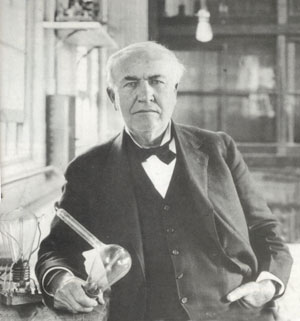
After all, Edison's work with the light bulb would have been an
interesting science experiment if it hadn't been tested in the real world and a host of other, supporting, innovations and the development of standard practices hadn't followed. And, even though Edison was recognized as the originator of the innovation, he didn't control its on-going development. For example, his use of direct current later lost out to the alternating-current system developed by the American inventors Nikola Tesla and George Westinghouse.

Looks like I've got my work cut out for me ...


Monday, December 26, 2005

Social Enterprise & Time Magazine's Persons of the Year

This may be the year of social enterprise awakening.

With megadisasters Katrina, Rita, the Asian Tsunami, the Pakistani Earthquake, Avian Flu, the AIDS Pandemic... there is a swelling urgency to find fast, effective business models to respond to--and possibly prevent--such wide-spread devastation.

Time Magazine has selected a trifecta of megastars in this field: rock band U2's frontman Bono alongside Bill & Melinda Gates.

The accompanying suite of articles gives an intimate glimpse of daily life for these three who are focused on massive systems, namely health and economics.

From Persons of the Year By NANCY GIBBS
And so another alliance was born: unlikely, unsentimental, hard nosed, clear eyed and dead set on driving poverty into history. The rocker's job is to be raucous, grab our attention. The engineers' job is to make things work. 2005 is the year they turned the corner, when Bono charmed and bullied and morally blackmailed the leaders of the world's richest countries into forgiving $40 billion in debt owed by the poorest; now those countries can spend the money on health and schools rather than interest payments--and have no more excuses for not doing so. The Gateses, having built the world's biggest charity, with a $29 billion endowment, spent the year giving more money away faster than anyone ever has, including nearly half a billion dollars for the Grand Challenges, in which they asked the very best brains in the world how they would solve a huge problem, like inventing a vaccine that needs no needles and no refrigeration, if they had the money to do it.

Saturday, December 17, 2005

The Rock Star's Burden

By PAUL THEROUX
Published: December 15, 2005 | NY Times Op-Ed

This is to balance out the post on Bono's ONE Manifesto.


THERE are probably more annoying things than being hectored about African development by a wealthy Irish rock star in a cowboy hat, but I can't think of one at the moment. If Christmas, season of sob stories, has turned me into Scrooge, I recognize the Dickensian counterpart of Paul Hewson - who calls himself "Bono" - as Mrs. Jellyby in "Bleak House." Harping incessantly on her adopted village of Borrioboola-Gha "on the left bank of the River Niger," Mrs. Jellyby tries to save the Africans by financing them in coffee growing and encouraging schemes "to turn pianoforte legs and establish an export trade," all the while badgering people for money.

It seems to have been Africa's fate to become a theater of empty talk and public gestures. But the impression that Africa is fatally troubled and can be saved only by outside help - not to mention celebrities and charity concerts - is a destructive and misleading conceit. Those of us who committed ourselves to being Peace Corps teachers in rural Malawi more than 40 years ago are dismayed by what we see on our return visits and by all the news that has been reported recently from that unlucky, drought-stricken country. But we are more appalled by most of the proposed solutions.
Read full article

[On a side note, my father, Philip P. Durand, served with Mr. Theroux in Malawi as part of the Peace Corps.]

Sunday, December 11, 2005

One: Bono = Numero Uno

The 2005 winner of the TEDPrize was the man with one name and the catalyst for the One Movement: Bono.

In his acceptance speech, he admonished the elite technorati to rise to the challenge of poverty and AIDS, he said:

But equality for Africa - that's a big, expensive idea. You see, the scale of the suffering numbs us into a kind of indifference. What on earth can we all do about this? Well, much more than we think. We can't fix every problem, but the ones we can, I want to argue, we must. And because we can, we must. This is the straight truth, the righteous truth. It is not a theory. The fact is that ours is the first generation that can look disease and extreme poverty in the eye, look across the ocean to Africa, and say this and mean it, "We do not have to stand for this." A whole continent written off,... we do not have to stand for this. [see video | read speech]
On Dec. 1, World AIDS Day, the inaugral podcast of the ONE Movement was broadcast. [ XML | HTML ]

The ONE Campaign seeks to end extreme poverty by allocating an additional ONE percent of the U.S. budget toward providing basic needs like health, education, clean water and food.
It is supported by Bill and Melinda Gates and the Bill & Melinda Gates Foundation. The ONE Campaign was founded by Bread for the World, CARE, DATA, International Medical Corps, International Rescue Committee, Mercy Corps, Oxfam America, Plan USA, Save the Children US, World Concern, and World Vision, and works closely with the National Basketball Association, Rock the Vote, and the Millennium Campaign.
The ONE declaration:

"WE BELIEVE that in the best American tradition of helping others help themselves, now is the time to join with other countries in a historic pact for compassion and justice to help the poorest people of the world overcome AIDS and extreme poverty. WE RECOGNIZE that a pact including such measures as fair trade, debt relief, fighting corruption and directing additional resources for basic needs - education, health, clean water, food, and care for orphans - would transform the futures and hopes of an entire generation in the poorest countries, at a cost equal to just one percent more of the US budget. WE COMMIT ourselves - one person, one voice, one vote at a time - to make a better, safer world for all."
Visit www.one.org for a podcast including Nelson Mandela, Coldplay, Val Kilmer and more hipsters with heart.

Thursday, December 08, 2005

The Purpose Prize

Do you know of someone in their 60s or older who is truly reinventing what it means to be an innovator in the social sector?

Civic Ventures, a San Francisco-based think tank and incubator, recognizes the incredible social capital represented in older adults. With funding from The Atlantic Philanthropies and The John Templeton Foundation, the organization is launching a campaign to recognize, invest in, and inspire this group of innovators.

They are offering The Purpose Prize.

The hallmark of this campaign is a prestigious new prize to five exceptional individuals over the age of 60 who are defying societal expectations by channeling their creativity and talent to address critical social problems at the local, regional, or national level. Sixty semi-finalists for The Purpose Prize -- "Sixty at Sixty+" -- will receive national recognition for their work.

Five $100,000 investments in Americans who are using their life experience and creativity to transform our nation and defy expectations for the second half of life.

Nominations are due by February 28, 2006.

Saturday, December 03, 2005

Don Gould, Pure Water for All

When people ask Don Gould how he knows that his product works, he answers, “Because babies stop dying.”


As part of a social enterprise consortium, Gould, who is both a product designer and ceramicist, helped to design and deploy simple effect water filtration devices to the developing world.

He talks with Tim Zak, host of Globeshakers, about both the traditional production techniques and the new economy models for collaboration. Together, they can deliver life-saving solutions that are as robust as they are elegant.
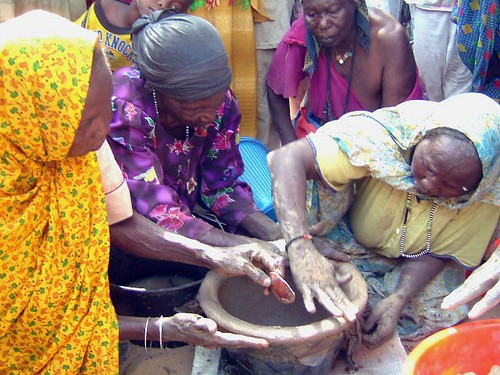
Sudan women making a filter.
See photos and slideshow from the Pure Water for All project in Sudan.

So, why is water a problem?

[see Globeshakers for more details.]

Darrell Hammond, founder of KaBOOM!

Play is a crucial factor in the overall well-being of children. It affects the level of quality of life they will enjoy. Yet, play in many communities, schools, and families has been pushed to the back-burner. Darrell Hammond, founder of KaBOOM!, envisions a great place to play within walking distance of every child in America. Since 1995, KaBOOM! has used its innovative community-build model to bring together business and community interests to construct more than 850 new playgrounds and skateparks and renovate 1,300 others nationwide.


On Nov. 4, 2005, Tim Zak, host of Globeshakers, speaks with Darrell Hammond, founder of KaBOOM!, who envisions a great place to play within walking distance of every child in America. Darrell gives a “State of the Union of Play” address regarding play in America, why it matters for the health of our children, and what it means for the future of the American workforce.