Sunday, January 16, 2011
Microfinance's Transition to Scale
Today's New York Times editorial by the Grameen Bank's Muhammad Yunus, Sacrificing Microcredit for Megaprofits, recommends a number of procedural and regulatory improvements to the "industry" of providing loans to the poor. Recent actions and reactions by for-profit loan providers, most notably in India, have dealt microfinance a "body blow". However, paradoxically, freedom and growth are often enhanced by establishing or better defining boundaries. I think that ultimately we'll look back on this moment in history as the time when microfinance became an even more robust and scalable way to eradicate poverty.


Thursday, November 18, 2010
Microcredit's Creative Destruction
An article in today's New York Times on the potential collapse of microcredit in India highlights the bumpy ride that always seems to accompany the growth of any new idea.
Apparently, some microcredit lenders in Andhra Pradesh, India's 4th largest state by population, crossed the fine line between balancing profits and social impact to loan sharking, all in the name of growth. It's easy to see why. Microfinance is increasingly becoming big business, in part because the need is so great, viable models (like those of the Grameen Bank) have become mainstream, and default rates are customarily low relative to profit margins.
And, most of all, people can get rich doing it. SKS Microfinance, India's largest for-profit microlender and backed by famous investors like George Soros and Vinod Khosla, recently floated a $350 million IPO with SKS Chairman Vikram Akula privately selling shares worth about $13 million.
The dynamics (another word for messiness) that accompany innovation and entrepreneurship have a familiar pattern. Early successes lead to refined models that produce ever increasing value to both customers and providers. Almost inevitably, these models are exploited by a few bad apples, sinking the whole concept into question.
Fortunately, all market-based innovations have built-in (although not always timely) mechanisms to clean up the mess. The refusal (or inability) of those receiving microloans to repay has already led to tighter regulatory restrictions and generated questions among policymakers, legitimate loan providers, and their customers. The answers to these questions, and the processes taken to find them, will undoubtedly lead to even better, more effective microcredit models in the future. Unfortunately, the "best" providers of microloans to the poor, which have pulled millions in poverty at least a rung or two up the economic ladder, will end up as collateral damage, at least for a while.
All of this is little comfort to the Indians whose lives have been damaged by unscrupulous lenders. It's a situation that has probably existed since the beginning of time and always will as long as those who have are willing to give to those who need.
Apparently, some microcredit lenders in Andhra Pradesh, India's 4th largest state by population, crossed the fine line between balancing profits and social impact to loan sharking, all in the name of growth. It's easy to see why. Microfinance is increasingly becoming big business, in part because the need is so great, viable models (like those of the Grameen Bank) have become mainstream, and default rates are customarily low relative to profit margins.
And, most of all, people can get rich doing it. SKS Microfinance, India's largest for-profit microlender and backed by famous investors like George Soros and Vinod Khosla, recently floated a $350 million IPO with SKS Chairman Vikram Akula privately selling shares worth about $13 million.
The dynamics (another word for messiness) that accompany innovation and entrepreneurship have a familiar pattern. Early successes lead to refined models that produce ever increasing value to both customers and providers. Almost inevitably, these models are exploited by a few bad apples, sinking the whole concept into question.
Fortunately, all market-based innovations have built-in (although not always timely) mechanisms to clean up the mess. The refusal (or inability) of those receiving microloans to repay has already led to tighter regulatory restrictions and generated questions among policymakers, legitimate loan providers, and their customers. The answers to these questions, and the processes taken to find them, will undoubtedly lead to even better, more effective microcredit models in the future. Unfortunately, the "best" providers of microloans to the poor, which have pulled millions in poverty at least a rung or two up the economic ladder, will end up as collateral damage, at least for a while.
All of this is little comfort to the Indians whose lives have been damaged by unscrupulous lenders. It's a situation that has probably existed since the beginning of time and always will as long as those who have are willing to give to those who need.
Tuesday, November 16, 2010
Clean Water, One Credit At A Time
Today's NY Times Fixes column features a solution proposed by Vestergaard Frandsen, maker of the LifeStraw which operates under a "Humanitarian Entrepreneurship" business model, to address the lack of clean water that afflicts many parts of the world.
In essence, the idea is to use the proceeds of carbon credits, which are increasingly becoming freely traded on global exchanges (like stocks and bonds), to finance investments in clean water solutions (including post-implementation support), thus making the cost of clean water = ZERO. Since boiling water for purification customarily uses carbon emitting energy sources like wood, it not only makes logical sense but Vestergaard Frandsen will make more $$$ the more successful they are at scaling adoption.
If there's one constant in the private sector it's that companies that introduce new, seemingly viable business models create hordes of fast-followers. This competition generates innovative energy that refines and fine tunes approaches, lowers costs, and provides a platform to "scale" solutions.
If there's anything surprising about what seems to be a surge of activity from the private sector to generate "profits with a purpose", it might be that it's taken this long to realize that, where there are societal problems of almost unimaginable magnitude, the mechanics of markets may provide a solution that also creates shareholder value.
In essence, the idea is to use the proceeds of carbon credits, which are increasingly becoming freely traded on global exchanges (like stocks and bonds), to finance investments in clean water solutions (including post-implementation support), thus making the cost of clean water = ZERO. Since boiling water for purification customarily uses carbon emitting energy sources like wood, it not only makes logical sense but Vestergaard Frandsen will make more $$$ the more successful they are at scaling adoption.
If there's one constant in the private sector it's that companies that introduce new, seemingly viable business models create hordes of fast-followers. This competition generates innovative energy that refines and fine tunes approaches, lowers costs, and provides a platform to "scale" solutions.
If there's anything surprising about what seems to be a surge of activity from the private sector to generate "profits with a purpose", it might be that it's taken this long to realize that, where there are societal problems of almost unimaginable magnitude, the mechanics of markets may provide a solution that also creates shareholder value.
Wednesday, November 03, 2010
Unreasonable Men and the Quest for a Malaria Vaccine
 |
| Billy Shore of Share Our Strength |
My good friend Billy Shore is the founder and executive director of Share Our Strength, one of the world's leading organizations in the quest to end childhood hunger. Billy was a senior aide to former U.S. Senators Gary Hart and Bob Kerrey and was selected as one of "America's Best Leaders" by U.S. News and World Report in 2005.
He has a new book coming out called The Imaginations of Unreasonable Men: Inspiration, Vision, and Purpose in the Quest to End Malaria (his fourth; see all of Billy's books here) which follows the story of two audacious scientists who have been racing each other for 30 years to develop the malaria vaccine. He uses the narrative to broach the question, “How do you solve the problems of hunger, disease, and other critical social problems with no natural market?”
Here an article link describing the book and Billy's insights on social innovation, published by Community Wealth Ventures, Share Our Strength's social enterprise consulting firm:
Monday, June 28, 2010
How To Make Your Car Smell Like French Fries
An article in today's Pittsburgh Post Gazette details a partnership that GTECH Strategies (Growth Through Energy and Community Health), a CMU-Heinz College social innovation spinoff and Echoing Green Fellowship winner, has with Pittsburgh-based Optimus Technologies / Fossil Free Fuels to collect used cooking oil from local restaurants and other institutions for use in vehicles with converted diesel engines. By their estimates, Pittsburgh generates an estimated 500,000 gallons of cooking oil annually, much of which is dumped in landfills or literally down the drain, causing not only environmental issues but an economic liability for companies.
GTECH has been filling brownfields with sunflowers for the past three years with the dual purposes of environmental remediation and economic development, and their efforts have expanded to areas including post-Katrina New Orleans. The partners have already secured $650,000 in grants this year to collect and convert vegetable oil, to convert engines and to build two alternative fueling stations.
As Andrew Butcher, CEO of GTECH and a Heinz College alum put it:
"This is a sweet spot for GTECH -- the economic potential in eliminating an environmental liability."
They are also working on a $1.6 million expansion plan that would generate 2.5 million gallons of renewable fuels per year and includes converting a block of abandoned buildings in Braddock (an economically distressed area of the city) for a vehicle conversion garage, fueling station, processing and distribution facility, and research lab for cooking and seed oil fuels.
I think this effort highlights some of the characteristics of next generation social innovation ventures--multidisciplinary, multipurpose, scalable, leveraged by strategic partnerships, and, perhaps most importantly, with a business plan that recognizes financial sustainability as a critical success factor.
What do you think?
GTECH has been filling brownfields with sunflowers for the past three years with the dual purposes of environmental remediation and economic development, and their efforts have expanded to areas including post-Katrina New Orleans. The partners have already secured $650,000 in grants this year to collect and convert vegetable oil, to convert engines and to build two alternative fueling stations.
As Andrew Butcher, CEO of GTECH and a Heinz College alum put it:
"This is a sweet spot for GTECH -- the economic potential in eliminating an environmental liability."
They are also working on a $1.6 million expansion plan that would generate 2.5 million gallons of renewable fuels per year and includes converting a block of abandoned buildings in Braddock (an economically distressed area of the city) for a vehicle conversion garage, fueling station, processing and distribution facility, and research lab for cooking and seed oil fuels.
I think this effort highlights some of the characteristics of next generation social innovation ventures--multidisciplinary, multipurpose, scalable, leveraged by strategic partnerships, and, perhaps most importantly, with a business plan that recognizes financial sustainability as a critical success factor.
What do you think?
Thursday, June 17, 2010
Innovating an Ancient Food

Yes, the simple spud is getting new attention as a way to stave off poverty and famine, maintain economic growth, and ensure social harmony. It simply takes less water to grow potatoes and their yield far more calories per acre (a great metric) than traditional alternatives.
The numbers describing the magnitude of the problem don't lie: China as to feed 1/5 of the world's population on 1/10 of the planet's arable land, and the nation's expanding cities are consuming farmland at breakneck speed.
China estimates that by 2030, when its population is expected to level off at roughly 1.5 billion, it will need to produce an additional 100 million tons of food each year.New, exotic potato varieties are being developed, a major potato research center is being launched in Beijing with the International Potato Center, and entrepreneurs are creating new potato-based foods in traditional forms (buns, noodles, cakes) to accelerate acceptance. In addition, the government has announced subsidies for farmers who grow high yield seed potatoes and expanded farmer training programs focused on innovative ways to raise crops (and rural incomes). And it's a good time to be in the Chinese potato business. Wholesale prices increased 85 percent from November to April, thanks in part to a severe drought that has limited supply.
Think these developments don't affect you? According to the article:
China has a long-standing policy of food self-sufficiency, growing 95 percent of the grain required to feed its people. The country's sheer size means that a major crop failure or other food emergency here could have international ramifications, overwhelming world food markets with sudden demand.Just goes to show that sometimes the catalysts for innovation are right in front of us. We just need to see the world in a new way.
Saturday, March 27, 2010
Latin America Redux
Nearly a year ago to the day, I returned from a trip through six Latin American countries--Chile, Argentina, Brazil, Peru, Columbia, and Mexico--searching for prospective students and partnerships for Carnegie Mellon's Heinz College campus in Australia. I learned during that month-long journey that common perceptions (at least mine) of a Latin America in relative poverty, suffering from governmental ineffectiveness, and experiencing continual economic chaos are largely overblown and many countries in the region were thriving in the midst of a global financial meltdown.
Well, I've just returned from Latin America again (same countries with the exception of Brazil, just not enough time this year) even more impressed with the region's progress and dynamism. For over three weeks, I gave lectures at universities, governmental organizations, companies, and public venues on social innovation and the forces influencing innovators throughout the world, particularly those focused on new ways to address basic human needs like clean water, food, shelter, health care, and education.
One presentation, Extreme Innovation: The Future of Products That Could Save The World, highlighted products aimed at supplying basic human needs in radical ways and included:
However, that doesn't stop us from one nagging question: whether the ideas, leaders, and institutions that exist in the present are better suited for a world now several centuries behind us? And, if that's the case, are the ways that we've traditionally tackled the challenges of our time hopelessly flawed and irrelevant for what we face in the future?
One thing that emerged in my thinking as a result of putting this lecture together is that design, technology, and the simultaneously decreasing cost of both bits and atoms is creating some very new ways to solve complex problems. One example is the recent DARPA Network Challenge to find ten red balloons randomly distributed throughout the US with the first person or organization to identify the location of all the balloons winning $40,000. Using a "recursive incentive structure" that built on existing social media tools, a group from the MIT Media Laboratory Human Dynamics Group located all ten balloons in just 8 hours and 56 minutes, showing the power of social and computer networks to address complex problems in orders of magnitude less time. See an interview of MIT physicist Riley Crane, the leader of the winning team, on a recent segment of the Colbert Report: http://civic.mit.edu/news/media-labs-riley-crane-on-colbert-report.
The interest in Extreme Innovation and the issues surrounding it seems limitless throughout Latin America and many of my presentations were to standing room only audiences (I think it's the topic, not the presenter!). Looks like Latin America could be on my speaking tour schedule for years to come!
Well, I've just returned from Latin America again (same countries with the exception of Brazil, just not enough time this year) even more impressed with the region's progress and dynamism. For over three weeks, I gave lectures at universities, governmental organizations, companies, and public venues on social innovation and the forces influencing innovators throughout the world, particularly those focused on new ways to address basic human needs like clean water, food, shelter, health care, and education.
One presentation, Extreme Innovation: The Future of Products That Could Save The World, highlighted products aimed at supplying basic human needs in radical ways and included:
- A definition of Extreme Innovation, building on decades of academic research and practical examples: "Products that defy conventional boundaries on cost, functionality, or other dimensions valued by end users, resulting in unexpectedly high social and economic impact."
- "Power Shifts" outlining some of the forces currently at work providing challenges and opportunities to innovators including demographic, urban and economic changes, technology influences, and the ongoing climate change debate.
- Some product examples including the LifeStraw, One Laptop Per Child, and Adaptive Eyecare's innovative glasses.
However, that doesn't stop us from one nagging question: whether the ideas, leaders, and institutions that exist in the present are better suited for a world now several centuries behind us? And, if that's the case, are the ways that we've traditionally tackled the challenges of our time hopelessly flawed and irrelevant for what we face in the future?
One thing that emerged in my thinking as a result of putting this lecture together is that design, technology, and the simultaneously decreasing cost of both bits and atoms is creating some very new ways to solve complex problems. One example is the recent DARPA Network Challenge to find ten red balloons randomly distributed throughout the US with the first person or organization to identify the location of all the balloons winning $40,000. Using a "recursive incentive structure" that built on existing social media tools, a group from the MIT Media Laboratory Human Dynamics Group located all ten balloons in just 8 hours and 56 minutes, showing the power of social and computer networks to address complex problems in orders of magnitude less time. See an interview of MIT physicist Riley Crane, the leader of the winning team, on a recent segment of the Colbert Report: http://civic.mit.edu/news/media-labs-riley-crane-on-colbert-report.
The interest in Extreme Innovation and the issues surrounding it seems limitless throughout Latin America and many of my presentations were to standing room only audiences (I think it's the topic, not the presenter!). Looks like Latin America could be on my speaking tour schedule for years to come!
Saturday, April 11, 2009
A Long Hiatus
Nearly three weeks ago, I returned to South America for the first time since 2000. That was the year that I took my first and only trip to the continent for my first training session at McKinsey in Caracas, Venezuela.
I remember a city crammed into a large valley surrounded by beautiful mountains carved into by desperate shanty towns and mansions walled off from unseen but very real dangers like some medieval castles. But the people, like I've encountered almost everywhere else in the world, were friendly, polite, and helpful. The food was delicious. The mood was a mixture of hope and a wariness developed through seemingly endless cycles of growing prosperity and leaders who failed to deliver on ambitious promises.
Santiago, Chile was my first stop in a five-week long journey of countless meetings with government leaders, scholarship providers, universities, and other representatives to raise awareness of Carnegie Mellon's Australia campus. In addition, we're working in conjunction with the South Australia government to offer generous partial scholarships that will result in more applicants from the region in our post graduate programs in public policy and management, and information technology.
According to the CIA World Factbook, Chile is one of the wealthier countries in South America with a per capita GDP (PPP) at 59th in the world and, according the the UN, a Human Development Index placing it in the world's top 40. Unfortunately, like much of Latin America (and many other parts of the world), it also has a vast gap between rich and poor with a 2006 Gini Index of 54.
Like Caracas, Santiago it sits in a bowl formed by majestic mountain ranges like the Andes with weather like South Australia which supports a similarly rich agriculture and wine industry.
My hotel was packed with tourists and tour groups from around the world, all looking to enjoy a safe, clean managable city of five million. Even in what were described as "poor" neighboorhoods, the "wealth gap" wasn't so obvious. It's hard to believe that less than twenty years ago, Chile was lead by Augusto Pinochet, a military dictator who rose to power in a violent 1973 coup.
One of the most obvious examples of how progressive the country's government has become is the recently announced Bicentennial Fund. Formed to celebrate Chile's upcoming 200th anniversary, the Fund was created by current President Michelle Bachelet (the only woman leader in Lantin America and the first in Chile's history) to provide thousands of post graduate scholarships to the country's "best and brightest" in areas like public policy and IT, and create a new generation of leaders throughout the government, business, and social sectors.
One country down, five to go. Next stop: Argentina.
I remember a city crammed into a large valley surrounded by beautiful mountains carved into by desperate shanty towns and mansions walled off from unseen but very real dangers like some medieval castles. But the people, like I've encountered almost everywhere else in the world, were friendly, polite, and helpful. The food was delicious. The mood was a mixture of hope and a wariness developed through seemingly endless cycles of growing prosperity and leaders who failed to deliver on ambitious promises.
Santiago, Chile was my first stop in a five-week long journey of countless meetings with government leaders, scholarship providers, universities, and other representatives to raise awareness of Carnegie Mellon's Australia campus. In addition, we're working in conjunction with the South Australia government to offer generous partial scholarships that will result in more applicants from the region in our post graduate programs in public policy and management, and information technology.
According to the CIA World Factbook, Chile is one of the wealthier countries in South America with a per capita GDP (PPP) at 59th in the world and, according the the UN, a Human Development Index placing it in the world's top 40. Unfortunately, like much of Latin America (and many other parts of the world), it also has a vast gap between rich and poor with a 2006 Gini Index of 54.
Like Caracas, Santiago it sits in a bowl formed by majestic mountain ranges like the Andes with weather like South Australia which supports a similarly rich agriculture and wine industry.
My hotel was packed with tourists and tour groups from around the world, all looking to enjoy a safe, clean managable city of five million. Even in what were described as "poor" neighboorhoods, the "wealth gap" wasn't so obvious. It's hard to believe that less than twenty years ago, Chile was lead by Augusto Pinochet, a military dictator who rose to power in a violent 1973 coup.
One of the most obvious examples of how progressive the country's government has become is the recently announced Bicentennial Fund. Formed to celebrate Chile's upcoming 200th anniversary, the Fund was created by current President Michelle Bachelet (the only woman leader in Lantin America and the first in Chile's history) to provide thousands of post graduate scholarships to the country's "best and brightest" in areas like public policy and IT, and create a new generation of leaders throughout the government, business, and social sectors.
One country down, five to go. Next stop: Argentina.
Watch This Space
The South Australian Government has an exceptionally innovative program called Thinkers In Residence which brings some of the world's leading intellectuals to the state for extended residencies. Their objective: make specific recommendations and catalyze actions in areas of critical importance to the state and, in many cases by extension, Australia and beyond. The current Thinker in Residence is my friend Laura Lee, former head of Carnegie Mellon's Architecture Department and an expert on sustainable design.
At the conclusion of the residency of Geoff Mulgan, head of the UK's Young Foundation and one of the world's leading thinkers on social innovation, last June South Australia's visionary Premier, Mike Rann announced the formation of the Australian Centre for Social Innovation (ACSI). This independent organization, seed funded with $6 million, intends to develop, test, and support innovative approaches to address the kinds of social problems endemic to South Australia and countless other "hotspots" around the world--clean and plentiful water, shelter, and renewable energy just to name a few.
On February 6, at an event honoring the memory of his political mentor, Mike announced that the ACSI was ready to spin-out from the nurturing incubation chamber provided by his government and formally named its inaugural Board, lead by Phillip Adams, one of Australia's leading commentators and polymaths. I was honored to be asked by the Premier to join this august group (albeit in a phone call taken during the 2nd quarter of Super Bowl XLIII, ultimately won by my beloved Pittsburgh Steelers).
In the weeks and months ahead, we'll name ACSI's first CEO, help shape its strategy and operational plan, and figure out where and how to start, borrowing liberally from and linking to related initiatives around the world.
As they say in Australia: "Watch This Space."
At the conclusion of the residency of Geoff Mulgan, head of the UK's Young Foundation and one of the world's leading thinkers on social innovation, last June South Australia's visionary Premier, Mike Rann announced the formation of the Australian Centre for Social Innovation (ACSI). This independent organization, seed funded with $6 million, intends to develop, test, and support innovative approaches to address the kinds of social problems endemic to South Australia and countless other "hotspots" around the world--clean and plentiful water, shelter, and renewable energy just to name a few.
On February 6, at an event honoring the memory of his political mentor, Mike announced that the ACSI was ready to spin-out from the nurturing incubation chamber provided by his government and formally named its inaugural Board, lead by Phillip Adams, one of Australia's leading commentators and polymaths. I was honored to be asked by the Premier to join this august group (albeit in a phone call taken during the 2nd quarter of Super Bowl XLIII, ultimately won by my beloved Pittsburgh Steelers).
In the weeks and months ahead, we'll name ACSI's first CEO, help shape its strategy and operational plan, and figure out where and how to start, borrowing liberally from and linking to related initiatives around the world.
As they say in Australia: "Watch This Space."
Thursday, January 15, 2009
An Affair To Remember
On December 11, 2008, Carnegie Mellon's Heinz College Australia had it's biggest graduating ceremony yet with 50 scholars representing nearly 20 different countries picking up their diplomas.

This year's graduation was moderated by Carnegie Mellon's Provost, Dr. Mark Kamlet (a former Dean of the Heinz College), and featured Alan Noble, the Engineering Director for Google Australia and a Heinz College Australia Advisory Board member, as the keynote speaker.


In my role as Executive Director of Carnegie Mellon Australia, I get to give the "Charge to the Graduates" at the end of the ceremony, which is kind of a gentle shove out the door, a verbal line of demarcation between life as a graduate student and the challenges of the "real world".
Here are my remarks from a remarkable day:
First of all, I’d like to add my congratulations to all of our graduates and, in particular, the trailblazers that make up our first graduating class of part-time students. As someone who got two graduate degrees while trying to hold down a job, have a life, and keep my wife from forgetting what I looked like, I know how challenging this journey has been for all of you. Make sure that you take at least a few minutes to take great pride in your accomplishments.
And that brings me to my Charge to the Graduates.
I was pretty proud to get accepted into Carnegie Mellon as an undergraduate in the early 1980’s, although I probably didn’t understand how significant it was at the time. I was a pretty good student but I have to admit that my primary focus in high school was sports and girls, not always in that order.
My life changed forever about halfway through my first day of orientation as a freshman. I was sitting between two guys in a packed lecture hall. On my left was a guy who had worked at an IBM research lab over the summer. On my right was a guy proudly talking about the computer he had just built from scratch, from soldering the circuit boards to writing the operating system. As I glanced down a couple of rows, I noticed another incoming student, obviously from somewhere outside the US, working on page-wide equations located on the back cover of our new calculus book.

As a computer science major that had taken one programming class in high school and got a ‘B’, I was clearly in a new land. Unfortunately, it was a land where I had the wrong kind of passport, didn’t speak the language, and the natives seemed hostile.
I learned something pretty important in that moment—my success or failure would be directly connected to how much I was willing to change and how hard I was willing to work. It was also reminded me that having a good dose of humility is a pretty desirable character trait.
I’ve had lots of challenges in my academic and professional life since then but getting through Carnegie Mellon is still the toughest thing I’ve ever done. Ever though I eventually graduated from CMU as a University Scholar, I was so happy that my time at Carnegie Mellon was over, and so intent to put that difficult period in my life behind me, that I chose not to stay in touch with the university for nearly a decade.
So I hope that our graduates, this year and every year, enter the world with what I’ll call a “confident humility”. That while they take great pride in the accomplishments that we recognize today, they balance that confidence with a recognition that they have stood on the shoulders of giants—friends, family, classmates, and colleagues—to get this far and that they’ll need other shoulders—to stand on, depend on, and occasionally cry on—to make their difference in the world.
Congratulations again to our graduates. All of us at the Heinz College hope that you won’t be as foolish as I was and let ten years go by before you let us know what you’re up to. You’re now officially part of the Carnegie Mellon family and, like the family and friends that are with you here today, we’ll be cheering you on every step of the way.
Thank You.
Photos courtesy of Roy VanDerVegt www.royvphotography.com.au


This year's graduation was moderated by Carnegie Mellon's Provost, Dr. Mark Kamlet (a former Dean of the Heinz College), and featured Alan Noble, the Engineering Director for Google Australia and a Heinz College Australia Advisory Board member, as the keynote speaker.


In my role as Executive Director of Carnegie Mellon Australia, I get to give the "Charge to the Graduates" at the end of the ceremony, which is kind of a gentle shove out the door, a verbal line of demarcation between life as a graduate student and the challenges of the "real world".
Here are my remarks from a remarkable day:
First of all, I’d like to add my congratulations to all of our graduates and, in particular, the trailblazers that make up our first graduating class of part-time students. As someone who got two graduate degrees while trying to hold down a job, have a life, and keep my wife from forgetting what I looked like, I know how challenging this journey has been for all of you. Make sure that you take at least a few minutes to take great pride in your accomplishments.
And that brings me to my Charge to the Graduates.
I was pretty proud to get accepted into Carnegie Mellon as an undergraduate in the early 1980’s, although I probably didn’t understand how significant it was at the time. I was a pretty good student but I have to admit that my primary focus in high school was sports and girls, not always in that order.
My life changed forever about halfway through my first day of orientation as a freshman. I was sitting between two guys in a packed lecture hall. On my left was a guy who had worked at an IBM research lab over the summer. On my right was a guy proudly talking about the computer he had just built from scratch, from soldering the circuit boards to writing the operating system. As I glanced down a couple of rows, I noticed another incoming student, obviously from somewhere outside the US, working on page-wide equations located on the back cover of our new calculus book.

As a computer science major that had taken one programming class in high school and got a ‘B’, I was clearly in a new land. Unfortunately, it was a land where I had the wrong kind of passport, didn’t speak the language, and the natives seemed hostile.
I learned something pretty important in that moment—my success or failure would be directly connected to how much I was willing to change and how hard I was willing to work. It was also reminded me that having a good dose of humility is a pretty desirable character trait.
I’ve had lots of challenges in my academic and professional life since then but getting through Carnegie Mellon is still the toughest thing I’ve ever done. Ever though I eventually graduated from CMU as a University Scholar, I was so happy that my time at Carnegie Mellon was over, and so intent to put that difficult period in my life behind me, that I chose not to stay in touch with the university for nearly a decade.
So I hope that our graduates, this year and every year, enter the world with what I’ll call a “confident humility”. That while they take great pride in the accomplishments that we recognize today, they balance that confidence with a recognition that they have stood on the shoulders of giants—friends, family, classmates, and colleagues—to get this far and that they’ll need other shoulders—to stand on, depend on, and occasionally cry on—to make their difference in the world.
Congratulations again to our graduates. All of us at the Heinz College hope that you won’t be as foolish as I was and let ten years go by before you let us know what you’re up to. You’re now officially part of the Carnegie Mellon family and, like the family and friends that are with you here today, we’ll be cheering you on every step of the way.
Thank You.
Photos courtesy of Roy VanDerVegt www.royvphotography.com.au
Wednesday, October 29, 2008
Learning Communities and Innovation
Earlier this week, I was a keynote speaker for the Australian Learning Communities Network Conference held in Adelaide, South Australia. Below are my comments:
I’ve been lucky enough to be part of some pretty interesting learning communities during the past 25 years or at least what I think of as learning communities. Whatever I know about them, a little or a lot, comes from direct experience—as a participant, a contributor, and a developer. So this morning, I’ll briefly provide what I believe are some of the characteristics of learning communities, why learning communities are necessary but perhaps not sufficient, and provide a quick example of what may be a prototype learning community for the 21st century.
*****
I can still remember my first day of orientation as a freshman at Carnegie Mellon’s US campus in Pittsburgh, about 700km west of New York City. I was sitting between two guys in a packed lecture hall. One of the guys had worked at an IBM research lab over the summer and the other was proudly talking about the computer he had just built from scratch, from soldering the circuit boards to writing the operating system. As a computer science major who had taken one programming class in high school and got a ‘B’, I was in a learning community where I had the wrong passport and didn’t speak the language. I learned something pretty important in that instant—my success or failure would be directly connected to how much I was willing to change, to disturb my status quo, and to take leaps into the unknown, time-and-time-and-time again.
When I got into the business world, I worked for companies whose very survival depended on cultivating learning communities, within and spanning vast geographies with thousands of contributors. For example, when I graduated from Carnegie Mellon, I went to work for IBM in an area just north of New York City dominated by the company’s manufacturing and R&D facilities. Along a 50km stretch of mostly two-lane roads, through little towns called Fishkill and Poughkeepsie and Wappingers Falls were some of the largest semiconductor and supercomputer manufacturing facilities in the world along with a higher concentration of advanced degrees and PhD’s than Silicon Valley. This wasn’t today’s IBM but the forgotten one of yesteryear, where employees all wore white shirts and could sing the company song and could expect lifetime employment. For a while in this learning community calculated risks were the norm and failure was never an option. But the comfortable environment and years of dominance lead to complacency and the ties that we formed to retain our intellectual advantage with sister plants in Europe and Japan, and with leading scientists and engineers around the world, frayed. For a while in the early 1990s, the company teetered on the brink of bankruptcy. The pressure and pace to rescue the company was unrelenting, and we probably never learned so much in such a short amount of time. As the author Willa Cather once said, “There are some things you learn best in calm, and some in storm.”
Fast forward to the height of the “dot com” meltdown in 2002 when I started an organization called the Social Innovation Accelerator with governments, philanthropies, corporations, universities, and nonprofits in Pittsburgh to make the city a learning community and global leader in the field of social innovation. Social innovations are novel solutions to social problems like homelessness or hunger or clean water that are more effective, efficient, or sustainable in the long-term than existing solutions and where the value created accrues primarily to society as a whole rather than private individuals. As if creating a learning community in a place still transitioning from a manufacturing-based economy to one reliant on education, services, and healthcare wasn’t enough, Pittsburgh has one of the highest concentrations of nonprofits per capita in the US with many operating about the same way they did when Apollo 11 landed on the moon. Before we could cultivate and support a learning community, we had to create a “community of unlearning”. As the poet James Russell Lowell said, “only by unlearning comes wisdom.”
I guess it’s not surprising that these experiences have influenced the development of the learning community that I’m now responsible for, Carnegie Mellon’s Heinz College, Australia. And not just the learning community that builds within the walls of our campus in Victoria Square but also how we can add, over time, to the “learning capital” of South Australia as well as what we like to call “The Triangle” from the Gulf States in the Middle East to China and South Korea down to Australia.
Sure, we have to have great facilities and learning tools and professors to support our students who represent twenty different countries. But we also need to do something much harder—create a culture and environment that supports change, disruption, and leaps into the unknown. Where learning by doing is supported by structured and just-in-time instruction. Where risk taking without lasting harm can be expected but where failure is still not considered an option. Where the yin of pressure and pace is occasionally unrelenting but where the yang of relaxation and release is also available. And where a “community of unlearning” exists and that spirit of questioning assumptions and not being afraid of reality spills out into the projects we do throughout the community for governments, nonprofits, and industry, in South Australia and beyond.
It’s an action-orientation that goes beyond learning for learning’s sake, and follows the original intention of the university’s founding benefactor, Andrew Carnegie, a self-educated entrepreneur whose Carnegie Steel Company grew to be the world’s largest producer of steel by the end of the 19th century. The Carnegie Technical School, the precursor to Carnegie Mellon University, was founded in 1900 on the premise that a learning community for the working class, the sons and daughters of steel workers and miners and craftsmen, was needed in the world. When the school was launched, Carnegie himself formally announced: “For many years I have nursed the pleasing thought that I might be the fortunate giver of a technical institute to our city, fashioned upon the best models, for I know of no institution which Pittsburgh, as an industrial center, so much needs.” So from the very beginning, following Carnegie’s lead and intentions, the university has focused on finding real solutions to the problems facing society by emphasizing multidisciplinary research, innovation, and entrepreneurship.
The Heinz College grew out of that tradition almost 40 years ago when it enrolled its first class of 13 students in what was then the School of Urban and Public Affairs. Today, we believe that the study of information technology and public policy, independently and jointly, provides a powerful platform from which to influence the world in the 21st century. We want nothing less than graduates who are driven to transform organizations, markets, and societies through information technology and provide leadership through intelligent action in pursuit of the public interest.
*****
And it’s that “action-orientation” that’s an important component of any truly vibrant learning community and the byproducts of actions arising from them—innovations, economically motivated or not—are what really make the difference.
In preparing my comments for today, just for fun, I went to the World Bank’s Knowledge for Development site, which houses two country indices:
However, what is perhaps not so expected, is that while the KI and KEI indices themselves are strongly correlated—that is, the diffusion of useful knowledge and its use to generate economic value appear mutually supportive—the relationship between things like education and ICT or education and innovation are not so clear-cut. Some countries apparently find ways to be innovative without widely distributing educational opportunities or ICT availability amongst its population. For example, Singapore is a wildly successful innovator with a literacy and higher education enrollment rate just above the world average, as is Armenia even though the availability of telephones, computers, and Internet connections in that country are well below the world average.
My quick analysis is not intended to make definitive statements on the critical success factors of learning communities or its connection to innovation. Only that, as many of you already know, learning communities depend on hard to identify and even harder to shape factors like the willingness for those in the community to take “safe risks” and submit to potentially uncomfortable learning situations as much as the number of libraries or availability of computers.
*****
I’ve been to the Middle East four times in just over the last year. Earlier this year, I was there when a futuristic 100,000-resident city named Masdar, meaning “the source” in Arabic, was announced. It’s intended to rise up from land across from the royal family’s private terminal at the Abu Dhabi airport. The goal: to create the world's first metropolis that emits not a single extra molecule of carbon dioxide, the cause of global warming.
It's a delicious irony that Abu Dhabi, awash in oil and dollars with nearly 100 billion barrels in reserves may be the place that builds the first city for a post-oil world. No cars will be allowed within the walled city’s limits. Billions will be poured into renewable and sustainable energy technologies.
$250 million has already been invested in clean-tech companies, including Segway, the maker of personal transporters, as well as solar manufacturers and wastewater-treatment companies. A new multi-billion dollar fund is working to allow Abu Dhabi's reach in renewable energy to extend all the way from research to large-scale manufacturing. By the time Masdar is complete in 2016, it will house 1,500 businesses, save the equivalent of $2 billion in oil over 25 years, create 70,000 jobs, and add more than 2 percent to Abu Dhabi’s GDP.
Of course, there are huge challenges ahead. The big question is whether enough talented scientists, engineers, and entrepreneurs can be persuaded to come to Abu Dhabi. The emirate's tiny population can’t furnish enough brains to develop an industry dependent on technological advances. But, in the heat of the desert, far from the world’s traditional centers of learning and innovation, is the start of a learning community that could literally change the world. It’s something that all of us should probably learn a little more about.
I’ve been lucky enough to be part of some pretty interesting learning communities during the past 25 years or at least what I think of as learning communities. Whatever I know about them, a little or a lot, comes from direct experience—as a participant, a contributor, and a developer. So this morning, I’ll briefly provide what I believe are some of the characteristics of learning communities, why learning communities are necessary but perhaps not sufficient, and provide a quick example of what may be a prototype learning community for the 21st century.
*****
I can still remember my first day of orientation as a freshman at Carnegie Mellon’s US campus in Pittsburgh, about 700km west of New York City. I was sitting between two guys in a packed lecture hall. One of the guys had worked at an IBM research lab over the summer and the other was proudly talking about the computer he had just built from scratch, from soldering the circuit boards to writing the operating system. As a computer science major who had taken one programming class in high school and got a ‘B’, I was in a learning community where I had the wrong passport and didn’t speak the language. I learned something pretty important in that instant—my success or failure would be directly connected to how much I was willing to change, to disturb my status quo, and to take leaps into the unknown, time-and-time-and-time again.
When I got into the business world, I worked for companies whose very survival depended on cultivating learning communities, within and spanning vast geographies with thousands of contributors. For example, when I graduated from Carnegie Mellon, I went to work for IBM in an area just north of New York City dominated by the company’s manufacturing and R&D facilities. Along a 50km stretch of mostly two-lane roads, through little towns called Fishkill and Poughkeepsie and Wappingers Falls were some of the largest semiconductor and supercomputer manufacturing facilities in the world along with a higher concentration of advanced degrees and PhD’s than Silicon Valley. This wasn’t today’s IBM but the forgotten one of yesteryear, where employees all wore white shirts and could sing the company song and could expect lifetime employment. For a while in this learning community calculated risks were the norm and failure was never an option. But the comfortable environment and years of dominance lead to complacency and the ties that we formed to retain our intellectual advantage with sister plants in Europe and Japan, and with leading scientists and engineers around the world, frayed. For a while in the early 1990s, the company teetered on the brink of bankruptcy. The pressure and pace to rescue the company was unrelenting, and we probably never learned so much in such a short amount of time. As the author Willa Cather once said, “There are some things you learn best in calm, and some in storm.”
Fast forward to the height of the “dot com” meltdown in 2002 when I started an organization called the Social Innovation Accelerator with governments, philanthropies, corporations, universities, and nonprofits in Pittsburgh to make the city a learning community and global leader in the field of social innovation. Social innovations are novel solutions to social problems like homelessness or hunger or clean water that are more effective, efficient, or sustainable in the long-term than existing solutions and where the value created accrues primarily to society as a whole rather than private individuals. As if creating a learning community in a place still transitioning from a manufacturing-based economy to one reliant on education, services, and healthcare wasn’t enough, Pittsburgh has one of the highest concentrations of nonprofits per capita in the US with many operating about the same way they did when Apollo 11 landed on the moon. Before we could cultivate and support a learning community, we had to create a “community of unlearning”. As the poet James Russell Lowell said, “only by unlearning comes wisdom.”
I guess it’s not surprising that these experiences have influenced the development of the learning community that I’m now responsible for, Carnegie Mellon’s Heinz College, Australia. And not just the learning community that builds within the walls of our campus in Victoria Square but also how we can add, over time, to the “learning capital” of South Australia as well as what we like to call “The Triangle” from the Gulf States in the Middle East to China and South Korea down to Australia.
Sure, we have to have great facilities and learning tools and professors to support our students who represent twenty different countries. But we also need to do something much harder—create a culture and environment that supports change, disruption, and leaps into the unknown. Where learning by doing is supported by structured and just-in-time instruction. Where risk taking without lasting harm can be expected but where failure is still not considered an option. Where the yin of pressure and pace is occasionally unrelenting but where the yang of relaxation and release is also available. And where a “community of unlearning” exists and that spirit of questioning assumptions and not being afraid of reality spills out into the projects we do throughout the community for governments, nonprofits, and industry, in South Australia and beyond.
It’s an action-orientation that goes beyond learning for learning’s sake, and follows the original intention of the university’s founding benefactor, Andrew Carnegie, a self-educated entrepreneur whose Carnegie Steel Company grew to be the world’s largest producer of steel by the end of the 19th century. The Carnegie Technical School, the precursor to Carnegie Mellon University, was founded in 1900 on the premise that a learning community for the working class, the sons and daughters of steel workers and miners and craftsmen, was needed in the world. When the school was launched, Carnegie himself formally announced: “For many years I have nursed the pleasing thought that I might be the fortunate giver of a technical institute to our city, fashioned upon the best models, for I know of no institution which Pittsburgh, as an industrial center, so much needs.” So from the very beginning, following Carnegie’s lead and intentions, the university has focused on finding real solutions to the problems facing society by emphasizing multidisciplinary research, innovation, and entrepreneurship.
The Heinz College grew out of that tradition almost 40 years ago when it enrolled its first class of 13 students in what was then the School of Urban and Public Affairs. Today, we believe that the study of information technology and public policy, independently and jointly, provides a powerful platform from which to influence the world in the 21st century. We want nothing less than graduates who are driven to transform organizations, markets, and societies through information technology and provide leadership through intelligent action in pursuit of the public interest.
*****
And it’s that “action-orientation” that’s an important component of any truly vibrant learning community and the byproducts of actions arising from them—innovations, economically motivated or not—are what really make the difference.
In preparing my comments for today, just for fun, I went to the World Bank’s Knowledge for Development site, which houses two country indices:
- The Knowledge Index (KI), measuring a country’s ability to generate, adapt, and diffuse knowledge using key variables related to education, innovation, and ICT, and
- The Knowledge Economy Index (KEI) that takes into account whether the country has an environment conducive for knowledge to be used effectively for economic development.
However, what is perhaps not so expected, is that while the KI and KEI indices themselves are strongly correlated—that is, the diffusion of useful knowledge and its use to generate economic value appear mutually supportive—the relationship between things like education and ICT or education and innovation are not so clear-cut. Some countries apparently find ways to be innovative without widely distributing educational opportunities or ICT availability amongst its population. For example, Singapore is a wildly successful innovator with a literacy and higher education enrollment rate just above the world average, as is Armenia even though the availability of telephones, computers, and Internet connections in that country are well below the world average.
My quick analysis is not intended to make definitive statements on the critical success factors of learning communities or its connection to innovation. Only that, as many of you already know, learning communities depend on hard to identify and even harder to shape factors like the willingness for those in the community to take “safe risks” and submit to potentially uncomfortable learning situations as much as the number of libraries or availability of computers.
*****
I’ve been to the Middle East four times in just over the last year. Earlier this year, I was there when a futuristic 100,000-resident city named Masdar, meaning “the source” in Arabic, was announced. It’s intended to rise up from land across from the royal family’s private terminal at the Abu Dhabi airport. The goal: to create the world's first metropolis that emits not a single extra molecule of carbon dioxide, the cause of global warming.
It's a delicious irony that Abu Dhabi, awash in oil and dollars with nearly 100 billion barrels in reserves may be the place that builds the first city for a post-oil world. No cars will be allowed within the walled city’s limits. Billions will be poured into renewable and sustainable energy technologies.
$250 million has already been invested in clean-tech companies, including Segway, the maker of personal transporters, as well as solar manufacturers and wastewater-treatment companies. A new multi-billion dollar fund is working to allow Abu Dhabi's reach in renewable energy to extend all the way from research to large-scale manufacturing. By the time Masdar is complete in 2016, it will house 1,500 businesses, save the equivalent of $2 billion in oil over 25 years, create 70,000 jobs, and add more than 2 percent to Abu Dhabi’s GDP.
Of course, there are huge challenges ahead. The big question is whether enough talented scientists, engineers, and entrepreneurs can be persuaded to come to Abu Dhabi. The emirate's tiny population can’t furnish enough brains to develop an industry dependent on technological advances. But, in the heat of the desert, far from the world’s traditional centers of learning and innovation, is the start of a learning community that could literally change the world. It’s something that all of us should probably learn a little more about.
Monday, October 20, 2008
Armageddon or Opportunity?
For the last few weeks, we've been inundated with news from the U.S. about falling stock prices, frozen credit markets, and bank failures. The situation is considered so dire in some circles that it's being called a "Financial Armageddon".
Without discounting the seriousness of the situation, particularly since world financial markets are so interconnected, history tells us that the next generation of innovators and entrepreneurs will likely see it as an opportunity.
According to the U.S. National Bureau of Economic Research from 1945 to 2007 there have been 10 recessions, lasting on average 10 months from peak to trough. I'm unfortunately old enough to distinctly remember at least four of them:
This list doesn't even include "Black Monday", October 19, 1987 when the U.S. stock market shed 508 points in a single day (22.6%). I'll never forget that day because, just before U.S. markets closed and it was clear that there had been a significant meltdown, the guy next door to me at IBM came into my office, sat down in a chair, put his head in his hands, and started to cry.
What so many people forget during times like these times is that an upended status quo might be the best time to invest in the new, still ill defined, status quo that will emerge from the chaos. Some world changing innovations, companies, and social entrepreneurs had their start during recessions, for example:
Without discounting the seriousness of the situation, particularly since world financial markets are so interconnected, history tells us that the next generation of innovators and entrepreneurs will likely see it as an opportunity.
According to the U.S. National Bureau of Economic Research from 1945 to 2007 there have been 10 recessions, lasting on average 10 months from peak to trough. I'm unfortunately old enough to distinctly remember at least four of them:

- 1973-1975 - A quadrupling of oil prices by OPEC coupled with high government spending due to the Vietnam War lead to stagflation in the U.S. (sound familiar?).
- 1980-1982 - The Iranian Revolution sharply increased the price of oil around the world in 1979, causing a global energy crisis (I can still remember even/odd license plate gas rationing). Tight monetary policy in the U.S. to control inflation lead to a recession.
- 1990-1991 - Driven by significant production and manufacturing-trade sales decreases, brought on, in part, by the rise of Japan's manufacturing prowess.
- 2001-2003 - Caused by the collapse of the dot-com bubble, 9/11, and accounting scandals driven by companies like Enron.
This list doesn't even include "Black Monday", October 19, 1987 when the U.S. stock market shed 508 points in a single day (22.6%). I'll never forget that day because, just before U.S. markets closed and it was clear that there had been a significant meltdown, the guy next door to me at IBM came into my office, sat down in a chair, put his head in his hands, and started to cry.
What so many people forget during times like these times is that an upended status quo might be the best time to invest in the new, still ill defined, status quo that will emerge from the chaos. Some world changing innovations, companies, and social entrepreneurs had their start during recessions, for example:
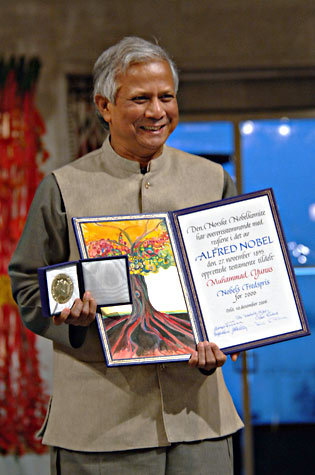
1973-1975 - Interactive laser discs and the first floppy disk drive make their debut. The first cell phone call is made at Motorola. One of the first commercial PCs, the Altair 8800, is shipped as a mail-order kit for $397. Paul Allen and Bill Gates write the first computer language program for personal computers; Gates later drops out of Harvard and founds Microsoft with Allen (and the rest, as they say, is history). In 1976, Steve Wozniak designs the first Apple computer and with Steve Jobs co-found Apple Computer. That same year, Muhammad Yunus (right) launches an "action research project" that eventually becomes the Grameen Bank, a groundbreaking social enterprise that nets Yunus the Nobel Prize in 2006.
- 1980-1982 - Atari becomes the first company to register a copyright for two computer games, "Asteroids" and "Lunar Lander". Iomega, Quantum, SGI, Maxtor, Symantec, Sun, Lotus, Compaq, Norton Utilities, and Adobe, all pioneering computer companies, are founded. IBM introduces the IBM Personal Computer with a starting price of $1,565. The first successful portable computer, the Osborne I (at 25 pounds!), is introduced. Apple is the first PC manufacturer to hit the $1 billion mark for annual sales.
- 1990-1991 - Tim Berners-Lee at CERN proposes a "hypertext" system, which is the start of the Internet as we know it today. Microsoft releases Windows 3.0 and sells more than 3 million copies in a year. The first search engine, Archie, is written by a team at McGill University in Canada. The National Science foundation opens the Internet to commercial use. Linux is introduced and the World Wide Web is launched to the public. Teach For America, the largest provider of teachers for lower income communities in the U.S., is launched as the result of a senior thesis by Princeton undergraduate student Wendy Kopp.
- 2001-2003 - Napster reaches over 26 million users in early 2001 (later filing for bankrupcy in 2002 due to record company litigation but too late to stop the digital music era). MacAfee introduces the first handheld virus protection software. Apple introduces the iPod. Early in 2004, Google launches Gmail.
Saturday, August 30, 2008
Aid Is Good, Business Is Better
 Africa is a country tantalizing in potential and seemingly perpetually in despair. So it was ironic that over breakfast today in Dubai, a global beacon of capitalism, I read an interesting commentary by Ellen Johnson-Sirleaf, the president of Liberia and Nicky Oppenheimer, the chairman of DeBeers in the weekend edition of the International Herald Tribune, the global edition of the New York Times.
They point out that “Africa is more democratic today than at any point since the start of decolonialization” and that “the amount of aid flowing to the continent, exceeding $30 billion, has never been greater.” And the global commodities boom has fueled economic growth rates, averaging 6.6% across sub-Saharan Africa. In fact, private capital flows to sub-Saharan Africa in 2007, mostly from investors in China, the Middle East and other parts of Asia, were estimated at $50 billion, far outdistancing direct aid and just getting started. So, they ask, why is Africa still lagging behind the rest of the world on most indicators of development?
Their claim is that, bucking the conventional wisdom that Africa doesn’t use aid properly, the real reason is the cost of doing business in Africa is too high. The authors cite a report from the International Finance Corporation that points out that 24 of the 30 countries with the most costly business environment are in sub-Saharan Africa, costs seldom borne by consumers but shouldered by African businesses and producers. They argue that the experiences of successful small and medium-sized economies elsewhere over the past 30 years have some important lessons for Africa, citing Costa Rica as an example, which has increased its per capita economy 250% over the past two decades, in going from an agricultural to a high-tech and services base:
- Competitiveness requires governments that can establish a framework for investment and step aside to let businesses thrive. Few countries in Africa have managed to establish and sustain a domestic political consensus around private sector growth and the often-painful reforms necessary to stimulate it.
- Countries must be willing to make a change in mind-set from the idea that foreign programs and plans will lift countries out of poverty to a belief in their own vision for their future. African governments need to sell the necessary reforms—to sell capitalism—at home. Foreign aid should only temporarily support countries while they implement difficult reforms and get on their feet.
- International debate on development must be reshaped. The heart of development is the relationship between governments, their citizens, and their own private sector—knocking down the main obstacles that entrepreneurs have in running a business like access to capital, electricity, transportation, telecommunications, taxes, labor, and corruption. Yet international debate on development is by and large still focused on the interaction of donors, nongovernmental organizations, and recipient governments. I like the part where they suggest complementing the United Nation’s Millennium Development Goals with a set of “development goals for competitiveness”.
Effective use of aid can support African reforms, but it must not be the organizing principle for African development. The key to success will be the extent to which African governments to provide the private sector the right incentives to add value to the economy, so both business and government can concentrate on what each does best.
Lawnmower Serenade
You can’t travel anywhere in Southeast Asia without noticing that motorcycles  and scooters are everywhere. They remind me of ants at a picnic--frenetically, chaotically, recklessly on the move, yet still maintaining some kind of strange order, heading toward some important, unseen object.
And if your eyes don’t notice all the activity, your ears sure will. Low on power, big on noise, the 2-wheelers, with their little 100-200cc engines often straining under heavy loads, sound like a typical Saturday morning suburb in the U.S. where mowing your lawn is a weekend rite of passage. But maybe, almost imperceptibly, the world is starting to change.
I was recently in a taxi in Malaysia when the driver and I struck up a conversation. After all, we both knew that the crush of rush hour traffic would make our 10km trip from the hotel to my first appointment take, oh, about an eternity (an hour, actuality, but who’s counting?). In the midst of apologizing about all the traffic, he noted that the price of cars is coming down so fast in Malaysia that they’re not that much more expensive than those ubiquitous motorcycles and, given the choice, everyone would rather have a car.
His comment got me thinking about another article that I had read just that morning about Tata’s new Nano, the “People’s Car” designed and manufactured to cost 1 lakh (about $2,500) and slated for sale by year-end. It’s been hailed as the “next Model T Ford or Volkswagen Beetle”, claims to meet European emissions standards with a fuel economy matching the best hybrids, and will be introduced with unique financing arrangements to put it within reach of millions of new consumers. Tata has even proposed that the Nano might be boxed up and sent to budding Indian entrepreneurs to finish assembly and provide ongoing maintenance—Toyota, meet Ikea.
But this particular article was about how its new plant in an impoverished part of India, West Bengal, is under siege by opposition party politicos and farmers who claim that Tata didn’t pay enough for the fertile farmland where the new factory sits. In the midst of its attempt to create 21st century jobs in a region where the clock is stuck in neutral, Tata has unwittingly generated a clash between economic growth and property rights, politics and profits, a known old and an uncertain new.
And this maelstrom won’t stop at the borders of West Bengal. The very idea of a car for the masses (and I’m talking about tens, if not hundreds, of millions of emerging consumers here) has something to tickle or enrage just about everyone.
Environmentalists will complain about more pollution and the acceleration of global warming that comes from having more cars on the road. Other “eco-nistas” will argue that, when these new emissions-friendly cars replace old exhaust belching gas-guzzlers, CO2 levels in the atmosphere might actually drop. Here’s an equation you don’t see everyday: more cars=less global warming?
Consumer advocates will celebrate the fact that traffic fatalities will drop (almost 5x higher per capita in India than in the West, driven primarily by pedestrians getting hit trying to cross busy intersections and motorcycle crashes with 4-wheeled vehicles). Urban planners will tear their hair out trying to figure out how traffic will move at all.
They all better start getting their arguments ready because, whether the Nano itself takes off or not, the world is going to witness a radical drop in the average price of a car. As seems to be the trend for so many radical, cost-trending-to-zero social innovations, the Nano has prompted global car makers like General Motors to announce their own micro-cost car development efforts, a predictable dance in an industry where everyone follows “just in case” and thus creates a trend line (see “SUV”).
The introduction of successful innovations always creates more questions than answers in the short term. But history tells us that we always find a way to adapt. Not that that’s very comforting as I sit in endless Kuala Lumpur traffic, listening to the lawnmower serenade.
 and scooters are everywhere. They remind me of ants at a picnic--frenetically, chaotically, recklessly on the move, yet still maintaining some kind of strange order, heading toward some important, unseen object.
 And if your eyes don’t notice all the activity, your ears sure will. Low on power, big on noise, the 2-wheelers, with their little 100-200cc engines often straining under heavy loads, sound like a typical Saturday morning suburb in the U.S. where mowing your lawn is a weekend rite of passage. But maybe, almost imperceptibly, the world is starting to change.
I was recently in a taxi in Malaysia when the driver and I struck up a conversation. After all, we both knew that the crush of rush hour traffic would make our 10km trip from the hotel to my first appointment take, oh, about an eternity (an hour, actuality, but who’s counting?). In the midst of apologizing about all the traffic, he noted that the price of cars is coming down so fast in Malaysia that they’re not that much more expensive than those ubiquitous motorcycles and, given the choice, everyone would rather have a car.
His comment got me thinking about another article that I had read just that morning about Tata’s new Nano, the “People’s Car” designed and manufactured to cost 1 lakh (about $2,500) and slated for sale by year-end. It’s been hailed as the “next Model T Ford or Volkswagen Beetle”, claims to meet European emissions standards with a fuel economy matching the best hybrids, and will be introduced with unique financing arrangements to put it within reach of millions of new consumers. Tata has even proposed that the Nano might be boxed up and sent to budding Indian entrepreneurs to finish assembly and provide ongoing maintenance—Toyota, meet Ikea.
But this particular article was about how its new plant in an impoverished part of India, West Bengal, is under siege by opposition party politicos and farmers who claim that Tata didn’t pay enough for the fertile farmland where the new factory sits. In the midst of its attempt to create 21st century jobs in a region where the clock is stuck in neutral, Tata has unwittingly generated a clash between economic growth and property rights, politics and profits, a known old and an uncertain new.
And this maelstrom won’t stop at the borders of West Bengal. The very idea of a car for the masses (and I’m talking about tens, if not hundreds, of millions of emerging consumers here) has something to tickle or enrage just about everyone.
Environmentalists will complain about more pollution and the acceleration of global warming that comes from having more cars on the road. Other “eco-nistas” will argue that, when these new emissions-friendly cars replace old exhaust belching gas-guzzlers, CO2 levels in the atmosphere might actually drop. Here’s an equation you don’t see everyday: more cars=less global warming?
Consumer advocates will celebrate the fact that traffic fatalities will drop (almost 5x higher per capita in India than in the West, driven primarily by pedestrians getting hit trying to cross busy intersections and motorcycle crashes with 4-wheeled vehicles). Urban planners will tear their hair out trying to figure out how traffic will move at all.
They all better start getting their arguments ready because, whether the Nano itself takes off or not, the world is going to witness a radical drop in the average price of a car. As seems to be the trend for so many radical, cost-trending-to-zero social innovations, the Nano has prompted global car makers like General Motors to announce their own micro-cost car development efforts, a predictable dance in an industry where everyone follows “just in case” and thus creates a trend line (see “SUV”).
The introduction of successful innovations always creates more questions than answers in the short term. But history tells us that we always find a way to adapt. Not that that’s very comforting as I sit in endless Kuala Lumpur traffic, listening to the lawnmower serenade.
Thursday, August 07, 2008
The Happiness Policy

I don't get to read for pleasure nearly as much as I'd like. In fact, a bookstore or library with full stacks and a good coffee shop is my idea of heaven (obviously it doesn't take much to make me happy). My best, too infrequent, opportunities are when I'm on the kind of vacation that I just got back from--long enough to relax, busy enough not to get bored, with plenty of in-between time to crack a good book (particularly if, like me, you suffer from jet lag-induced insomnia).
One from this latest stack was particularly good: The Geography of Bliss by a US National Public Radio Correspondent Eric Weiner (see the NY Times book review article here). It chronicles the curmudgeonly author's efforts to find the happiest places in the world (contrasted with a few of the unhappiest) and find out why the people who live there are so, well, happy. His travels take him from the Netherlands (home of the World Database of Happiness, housed in a surprisingly sober, data intensive research organization) to places like Iceland, India, Qatar, and Bhutan. Weiner points out that social scientists have found that personal happiness is highly correlated with the things that money can't buy like close relationships, solid family lives including loving spouses/partners, and engaging in genuine acts of kindness. But researchers have also found that one of the things that contributes to personal happiness is faith in their government: that senior officials and the rest of the public service are capable, caring, and consistent in their efforts to serve constituents.
It made me remember part of a speech that I gave here in Australia on the changing nature of business and the role of 21st Century governments. In that speech, I quoted the 18th Century UK moral philosopher Jeremy Bentham who argued that the purpose of politics should be to bring the greatest happiness to the greatest number of people. I also cited a 2006 survey in the UK that found that 81% of those polled thought that government should focus on happiness, not wealth creation.
Just for fun, before the talk, I had decided to see if there was any correlation between a country’s wealth, measured in per capita Gross National Product and its Happiness Index score which is published by researchers at Britain's University of Leicester. Sure enough, more wealth a country has, the happier its people are--up to a point, around $50,000USD per year, according to researchers. But there were a huge number of outliers--countries where people are very happy yet relatively poor (like Bhutan). When undertaking the analysis from a Purchasing Power Parity perspective (in a crude attempt to "level out" income disparities) there were even more outlier countries.
Reading The Geography of Bliss reminded me that these are the kinds of important public policy questions that we love to propose and tackle at the Heinz School--perhaps a little offbeat and counterintuitive, often data intensive, with broad implications on the management decisions made by government and business leaders affecting potentially millions of people, if not everyone on the planet. And it also reminded me that I need to get to Iceland someday...
Sunday, June 08, 2008
Make the Impossible Possible
Every once in a while you get introduced to someone who will change your life, and the way you view the world, forever. In the winter of 2000, I was in a downtown Manhattan hotel room with a bad case of insomnia after a long day of trying to figure out how to "kill" Napster for one of McKinsey's media company clients. Suddenly, I was jolted to attention by a TV interview. Some guy was talking about charities that earn their own revenue instead of depending on handouts, introducing a term--social enterprise--that was conspicuously missing from all of my business school classes.
Turned out that the "guy" was Billy Shore, founder of Share Our Strength,
 one of the world's leading hunger relief organizations and a former senior staffer for U.S. Senators Gary Hart and Bob Kerrey. The interview was to support his is book, The Cathedral Within, which does a masterful job of explaining "community wealth" (his term for social enterprise) and uses SOS and other great nonprofits as convincing case studies. A couple of years later, I met Billy (a fellow Pittsburgher now based in Washington, DC) and we became fast friends. Just goes to show that life has a way of producing mysterious, wonderful twists and turns, even when you're not paying close attention.
*****
Like Billy Shore, Bill Strickland is a good friend, a hero for the planet, and a force of nature that has dedicated his life to changing the world. If you haven't heard of Bill Strickland then click on this link right now: it's an interview that I did with him for Globeshakers.
Bill founded an organization on Pittsburgh's tough north side (or norside in Pittsburgh-ese) almost 40 years ago called the Manchester-Bidwell Corporation which includes the Bidwell Training Center and the Manchester Craftsmen's Guild. MBC provides job training programs to adults and arts programs to high schoolers. But it's not what MBC does that's so different. After all there are lots of these programs around the world. It's how and where they do it--in a building designed by a student of famed architect Frank Lloyd Wright, filled with orchids (grown in MBC greenhouses) and beautiful artwork, the sounds of jazz and the smells of freshly cooked cuisine filling the hallways.
And its hard to argue with the results. For example, less than half of kids entering Pittsburgh high schools graduate but nearly 90% of MBC's students, drawn from the same population, get their diploma with nearly 90% of those continuing their education in trade schools, community colleges, and universities. When I was CEO of the Accelerator, we were lucky to have MBC as one of our portfolio ventures.
And Strickland is a social entrepreneur par excellence. Lab technician training programs with Bayer Corporation, sales of award-winning orchids to local supermarkets, and the expansion of MBC to cities like San Francisco, Grand Rapids, and Cincinnati. MCG Jazz, MBC's record label, has won four Grammy Awards and, led by Executive Producer Marty Ashby, maintains one of the longest running jazz concert series in the U.S., its stage graced by legends like Dizzy Gillespie, Herbie Hancock, and Nancy Wilson.

Just out is Bill's new book, Make the Impossible Possible. The subtitle pretty much says it all: One Man's Crusade to Inspire Others to Dream Bigger and Achieve the Extraordinary. I don't get to read nearly as much as I'd like but I put this one on top of the stack (which, if toppled, could cause serious personal and physical damage) as soon as I got it. And I wasn't disappointed. It's an inspiring and uplifting primer for social entrepreneurs, those who support them, or anyone interested in new ways to fix old problems. But don't just take it from me--even my Mom loved it!
Make the Impossible Possible is a must read for anyone interested in Shaking Up The Globe.
East Meets West

A few weeks ago, I was in China at the invitation of my friends at the Chinese Executive Leadership Academy, Pudong (CELAP), located in the outskirts of Shanghai, to present a lecture to thirty high-level government officials. I had been given a daunting task: provide key decision makers in the world's fastest growing economy some new ideas on how governments can create "fertile ground" for innovators in industry, communities, and even the public service itself.
Over a memorable afternoon (at least for me!), we wrestled with what innovation is, what motivates innovators to act, and the lessons that history has to teach us about what
 works and what doesn't. Before a spirited Q&A session, we talked about the historic role of government in creating innovative societies and some of the best contemporary examples of innovative governments in action around the world. Luckily, I had lots of great ideas to draw on including some groundbreaking work that my friend Geoff Mulgan, now head of the U.K.'s Young Foundation, developed while working as a strategy guru in the Blair government.
Invitations like these are a great way to highlight the Heinz School's long history of breakthrough thinking about innovation and its impact on government, industry, and communities around the world. It also gives me a chance to further develop Heinz-Australia'
 s growing partnerships with high profile organizations, like CELAP, in the "triangle" from the Gulf States to Asia to Australia. My discussions with two of CELAP's key officials (Mr. Jiang and Dr. Bai pictured) will further expand our ability to recruit students, develop executive education offerings, and create stronger ties to one of the world's most fascinating and influential regions.
Tuesday, February 26, 2008
Clear Air Turbulence
Last week, I was a plenary speaker at a conference focused on whether South Australia is poised to become an "economic powerhouse". The title of my talk was Clear Air Turbulence: The Promise and Peril of Emerging Economic Powerhouses.
INTRODUCTION
I’ll admit that I have a love-hate relationship with flying. But throughout my professional life, and certainly in my current job as the Executive Director of Carnegie-Mellon’s Asia-Pacific campus here in Adelaide, it kind of goes with the territory. Last year I went from getting my Qantas frequent flier card to achieving, I think, something like plutonium level status, which allows me to fly the plane if I want.
It’s not that I don’t love visiting far-flung places. I do. But, after all of these years, I still can’t get comfortable with the idea of climbing into an enormously heavy metal tube that depends only on the laws of physics and lots of variables—pilot skill, weather, mechanicals—to stay aloft. Sure, I say to myself, the chances of a crash are pretty remote. But so is surviving one.
What really bothers me are those times when it’s a perfect day to fly, blue sky as far as the eye can see, and the plane unexpectedly starts to pitch and wobble and jump—what aeronautical engineers would call “clear-air turbulence”. Clear-air turbulence is caused when bodies of air moving at widely different speeds meet, and it’s impossible to detect either with the naked eye or conventional radar, meaning that it’s difficult to avoid.
As is turns out, if we hadn’t figured out at least some of the properties of clear-air turbulence modern air travel, as we know it today, probably wouldn’t exist.
As test pilot Chuck Yeager got closer and closer to flying at Mach 1, the sound barrier, the aerodynamic drag of his plane, coupled with the uncertainty of clear-air turbulence, became so extreme that engineers thought that there might be some sort of physical barrier to travel at or beyond the speed of sound. Through new innovations, experimentation, and the sheer courage and will of Yeager the sound barrier was broken in October 1947, the effects of clear-air turbulence at Mach 1 were conquered and the world has never been the same.
*****
Much of what we’ve heard at this conference has reinforced what’s been portrayed by industry, government, and the media about South Australia’s future—sure, there are some challenges to overcome but it looks like there is a lot of clear blue sky out there. More money, more people, certainly more influence in the Australian, if not the global, economy.
Now, I think it’s dangerous to make predictions, especially about the future. But I think that there are at least three big shifts happening in the world, perhaps the clear-air turbulence in an otherwise blue sky, that will require businesses, governments, and nonprofits like philanthropies, social service agencies, and universities like mine to have the courage and will to innovate and experiment if they hope to be around to see the last shovel of rock get mined from Olympic Dam. I’d like to spend the rest of my time with you today briefly describing these three shifts and some thoughts about the promise and peril that South Australia could face if the dream of an “economic powerhouse” comes true.
*****
Shift #1: The best customers in the world will have no money.
O.K., I exaggerated a little bit. Some of the best customers in the world or the customers of your best customers will have almost no money.
Many of us probably have a sense for how wide the difference in income levels are around the world. In fact, 80% of the world’s wealth is controlled by 15% of the world’s population, and the poorest 50% have only 1% of the world’s wealth. An estimated four billion people around the world live on less than $5 a day.
But, of the next 2 billion people to inhabit the planet, only 50 million of them will live in the developed world. With a global economy growing at more than 5% and a world population growing at a little over 1%, the average world per capita income is growing at a rate such that poverty could be cut by more than half by 2015.
This means that almost a billion new consumers will enter the global marketplace in the next decade, getting beyond the level of annual household income, about $5,000, when people generally begin to spend on discretionary goods. When you put all these numbers together, it results in consumer spending power in emerging economies increasing from $4 trillion to more than $9 trillion—nearly the current spending power of Western Europe.
Of course, these consumers will be harder to reach through traditional means, even with mass migrations around the world from rural to urban areas. Tapping into this big emerging market, even for companies that don’t provide goods directly to consumers, will require very, very new ways of thinking.
For example, this is Muhammad Yunus, the winner of the 2006 Nobel Peace Prize and the founder of the Grameen Bank of Bangladesh. You may already know the story of this social entrepreneur who, over 30 years ago, gave loans totaling $42 to 24 Bangladeshi women to launch micro-businesses and ultimately legitimized microfinance as not only a poverty alleviation strategy but a viable business model. As of January 2008, Grameen had nearly 7.5 million borrowers, 97 percent women, with branches covering more than 96 percent of all villages in the country. With over $7 billion in loans distributed since its inception in 1976, Grameen Bank, 90% of which is owned by its customers with the remaining 10% owned by the government, has had only three unprofitable years and a less than 3% default rate.
Not surprisingly, perhaps, established companies have started to get in the game. Late last year, JPMorgan launched its new Social Sector Finance unit intended to “achieve a double bottom line of social benefit and financial returns.” You might think that JPMorgan was particularly forward thinking here but they were merely responding to similar initiatives by other financial services companies including Morgan Stanley, HSBC, and Deutsche Bank.
And it’s a trend not just limited to the banking sector. Groupe Danone of France launched in 2006 with the Grameen Bank Grameen Danone Foods to manufacture nutrient-rich, fortified yogurt in small local plants. That approach minimizes the need for expensive refrigeration and reduces the price so that more rural children in Bangladesh can improve their diets. But Danone isn’t just launching this venture to eradicate malnutrition. Both partners expect to make money on the deal and establish a new business model that can be profitably scaled to other parts of the developing world.
Shift #2: Competitors will come from places that make almost no sense at all.
I don’t need to tell many of you in the room that competition seems to get fiercer every year. And, if South Australia becomes even more of a global player in the world economy expect that trend to continue, and then some.
The average life expectancy of a multinational corporation is between 40 and 50 years and rapidly decreasing. For example, more than 1 in 3 Fortune 500 companies in the U.S. from 1995-2004 experienced bankruptcy or takeover and a similar effect is taking place in most developed economies across Europe and Asia.
In addition, the average holding period for a share of common stock is about ten times shorter than it used to be—from 8 years to 8 months—and product life cycles have reduced by a factor of 3.
One reason for these, perhaps frightening conditions is that new products and business models are emerging from some pretty unlikely places.
For example…
Shift #3: The definition of “success” will change.
I tend to agree with the famed economist Milton Friedman that the sole purpose of a business is to make money. But there are forces at work that are beginning to change what “business success” means.
Governments, which should do at least two things well—#1: establish rules and #2: create incentives—are increasingly introducing double or even triple bottom line rules and incentives to drive industrial and economic policies. Do well financially, do well by the community, and do well by the environment—an infinitely more complicated operating environment with different governments around the world reacting differently to the emerging needs of society in the 21st century.
In addition, investors are devising more sophisticated ways to assess a company’s “intrinsic value”. When Al Gore left the White House in 2000, he listed his net worth at around $2 million. Eight years later, he’s worth between $50-$100 million. Can you get that much cash that fast through speaking engagements? Not likely. Winning the Nobel Prize. Hardly. Getting options on Google and Apple stock by sitting on their boards? Perhaps.
No, it seems likely that Gore’s newfound wealth could largely be attributed to the founding of his investment company, Generation Investment Management, founded with a former Goldman Sachs partner, David Blood (fortunately, they resisted the urge to call the new firm Blood and Gore). Generation has developed new, highly sophisticated modeling and analytical techniques, taking into account environmental and community impact indicators as well as prospects for future profitability, to estimate future stock prices and make investment decisions. Returns of the firm’s investment portfolio haven’t been made public but Gore is reportedly “very pleased” with the results.
It’s likely that Generation Management is using methodologies similar to those used in Fortune Magazine’s annual Accountability Rating of the world’s 100 largest companies. Last year’s evaluation reflected a further evolution of the approach used when it was first calculated in 2005, becoming increasingly more invasive.
How much longer will it be until it gets applied to even more companies, and media competitors apply their own scrutiny to the financial, social, and environmental practices of global corporations?
And if you can’t get investment capital from banks, private equity firms, or the growing sovereign accounts of countries, how about Google? Last year, the company’s philanthropic arm, Google.org, established investment initiatives in five major areas including Developing Renewable Energy Cheaper Than Coal called RE
Or how about the Gates Foundation which, given the recent commitment by Warren Buffet to contribute his vast wealth to the foundation, is redoubling its efforts to reshape health care and medical research around the world, often using unconventional methods and operating models borrowed from the private sector?
Or, if you’re a more competitive sort, how about vying for an X-Prize. Like the $25,000 that got Charles Lindberg to fly cross the Atlantic, a $10 million prize was enough to motivate some of the best engineers in the world to try to send a man into space, bring him home safely, and do it all over again in four days—a truly reusable space ship. It was pulled off by legendary airplane designer Burt Ruttan in 2004 and has ushered in the era of personal space travel, with entrepreneurs like Richard Branson rushing to enter the market. Now there are X-Prizes for things like the 100-mile per gallon (44km/liter) vehicle, greenhouse gas scrubbers, and wearable power.
*****
So let’s assume that South Australia’s companies, government, and nonprofit sector successfully navigates through this turbulence and emerges an “economic powerhouse”. What are the decisions and responsibilities that come with that kind of success?
That’s a pretty big question for the time that I have left so let me just leave you with some things to think about.
Last year, a university professor in the UK, Adrian White, completed an analysis called “A Global Projection of Subjective Well-Being”. The shorthand for his work, ranking every country in the world, has been called the “Happiness Index” because it attempted to apply a systematic approach to assessing relative contentment among global populations.
Now this may sound like a pretty difficult, perhaps even foolhardy task, but it’s an important one, especially for governments. In fact, the UK moral philosopher Jeremy Bentham in the late 1700’s argued that the purpose of politics should be to bring the greatest happiness to the greatest number of people. A 2006 survey in the UK found that 81% thought that the government should focus on happiness, not wealth creation.
Just for fun, I decided to see if there was any correlation between a country’s wealth, measured in per capita Gross National Product and its Happiness Index score.
It’s no surprise that people in high GNP per capita countries are generally pretty happy but what’s interesting is that there were lots of low GNP per capita countries where citizens were about as content.
So, I thought, maybe it’s because the cost of living is different in different countries. So I did the same analysis using data that equalizes GNP per capita based on a country’s relative cost of living.
You can see that the previous conclusion is even more obvious here—money alone doesn’t seem to guarantee happiness or, more importantly for governments, the contentment of its citizens.
Similarly, the United Nations publishes a “Human Development Index” that includes literacy rates, life expectancy, and other indicators of a “well developed” society.
Still, when compared to per capita GNP, even some of the world’s richest countries don’t stack up. Of course, it’s hard to draw firm conclusions but it would appear that the effective provision of important human needs such as healthcare, education, and housing—effectively and economically delivered increasingly with the cooperation of governments, industry, and the nonprofit sector—is an important determinant of societal development.
*****
I was in the United Arab Emirates a couple of weeks ago and places like Abu Dhabi and Dubai are interesting case studies of economic powerhouses on the move. It made me think about the choices and opportunities that South Australia might have in the future.
While I was there, a futuristic 100,000-resident city named Masdar meaning “the source” in Arabic, was announced, intending to rise up from land across from the royal family’s private terminal at the Abu Dhabi airport. The goal: to create the world's first metropolis that emits not a single extra molecule of carbon dioxide, the cause of global warming.
It's a delicious irony that Abu Dhabi, awash in oil and dollars with nearly 100 billion barrels in reserves may be the place that builds the first city for a post-oil world. No cars will be allowed within the walled city’s limits. Billions will be poured into renewable and sustainable energy technologies.
$250 million has already invested in clean-tech companies, including Segway, the maker of personal transporters, solar manufacturers, and wastewater-treatment companies. A new multi-billion dollar fund is working to allow Abu Dhabi's reach in renewables to extend all the way from research to large-scale manufacturing. By the time Masdar is complete in 2016, it will house 1,500 businesses, save the equivalent of $2 billion in oil over 25 years, create 70,000 jobs, and add more than 2 percent to Abu Dhabi’s GDP.
Of course, there are huge challenges ahead. The big question is whether enough talented scientists, engineers, and entrepreneurs can be persuaded to come to Abu Dhabi. The emirate's tiny population can’t furnish enough brains to develop an industry dependent on technological advances. Sound familiar, South Australia?
But the payoffs from success are almost immeasurable, especially when you consider the fact that China is building the equivalent of four new Manhattans every single year.
It’s obviously premature, but what would South Australia’s Masdar be if the promise of economic growth and prosperity became a reality? Like it or not, great opportunities and sometimes awesome responsibilities go along with being a “big dog” on the world’s economic stage.
Thank you.
*****
INTRODUCTION
I’ll admit that I have a love-hate relationship with flying. But throughout my professional life, and certainly in my current job as the Executive Director of Carnegie-Mellon’s Asia-Pacific campus here in Adelaide, it kind of goes with the territory. Last year I went from getting my Qantas frequent flier card to achieving, I think, something like plutonium level status, which allows me to fly the plane if I want.
It’s not that I don’t love visiting far-flung places. I do. But, after all of these years, I still can’t get comfortable with the idea of climbing into an enormously heavy metal tube that depends only on the laws of physics and lots of variables—pilot skill, weather, mechanicals—to stay aloft. Sure, I say to myself, the chances of a crash are pretty remote. But so is surviving one.
What really bothers me are those times when it’s a perfect day to fly, blue sky as far as the eye can see, and the plane unexpectedly starts to pitch and wobble and jump—what aeronautical engineers would call “clear-air turbulence”. Clear-air turbulence is caused when bodies of air moving at widely different speeds meet, and it’s impossible to detect either with the naked eye or conventional radar, meaning that it’s difficult to avoid.
As is turns out, if we hadn’t figured out at least some of the properties of clear-air turbulence modern air travel, as we know it today, probably wouldn’t exist.
As test pilot Chuck Yeager got closer and closer to flying at Mach 1, the sound barrier, the aerodynamic drag of his plane, coupled with the uncertainty of clear-air turbulence, became so extreme that engineers thought that there might be some sort of physical barrier to travel at or beyond the speed of sound. Through new innovations, experimentation, and the sheer courage and will of Yeager the sound barrier was broken in October 1947, the effects of clear-air turbulence at Mach 1 were conquered and the world has never been the same.
*****
Much of what we’ve heard at this conference has reinforced what’s been portrayed by industry, government, and the media about South Australia’s future—sure, there are some challenges to overcome but it looks like there is a lot of clear blue sky out there. More money, more people, certainly more influence in the Australian, if not the global, economy.
Now, I think it’s dangerous to make predictions, especially about the future. But I think that there are at least three big shifts happening in the world, perhaps the clear-air turbulence in an otherwise blue sky, that will require businesses, governments, and nonprofits like philanthropies, social service agencies, and universities like mine to have the courage and will to innovate and experiment if they hope to be around to see the last shovel of rock get mined from Olympic Dam. I’d like to spend the rest of my time with you today briefly describing these three shifts and some thoughts about the promise and peril that South Australia could face if the dream of an “economic powerhouse” comes true.
*****
Shift #1: The best customers in the world will have no money.
O.K., I exaggerated a little bit. Some of the best customers in the world or the customers of your best customers will have almost no money.
Many of us probably have a sense for how wide the difference in income levels are around the world. In fact, 80% of the world’s wealth is controlled by 15% of the world’s population, and the poorest 50% have only 1% of the world’s wealth. An estimated four billion people around the world live on less than $5 a day.
But, of the next 2 billion people to inhabit the planet, only 50 million of them will live in the developed world. With a global economy growing at more than 5% and a world population growing at a little over 1%, the average world per capita income is growing at a rate such that poverty could be cut by more than half by 2015.
This means that almost a billion new consumers will enter the global marketplace in the next decade, getting beyond the level of annual household income, about $5,000, when people generally begin to spend on discretionary goods. When you put all these numbers together, it results in consumer spending power in emerging economies increasing from $4 trillion to more than $9 trillion—nearly the current spending power of Western Europe.
Of course, these consumers will be harder to reach through traditional means, even with mass migrations around the world from rural to urban areas. Tapping into this big emerging market, even for companies that don’t provide goods directly to consumers, will require very, very new ways of thinking.
For example, this is Muhammad Yunus, the winner of the 2006 Nobel Peace Prize and the founder of the Grameen Bank of Bangladesh. You may already know the story of this social entrepreneur who, over 30 years ago, gave loans totaling $42 to 24 Bangladeshi women to launch micro-businesses and ultimately legitimized microfinance as not only a poverty alleviation strategy but a viable business model. As of January 2008, Grameen had nearly 7.5 million borrowers, 97 percent women, with branches covering more than 96 percent of all villages in the country. With over $7 billion in loans distributed since its inception in 1976, Grameen Bank, 90% of which is owned by its customers with the remaining 10% owned by the government, has had only three unprofitable years and a less than 3% default rate.
Not surprisingly, perhaps, established companies have started to get in the game. Late last year, JPMorgan launched its new Social Sector Finance unit intended to “achieve a double bottom line of social benefit and financial returns.” You might think that JPMorgan was particularly forward thinking here but they were merely responding to similar initiatives by other financial services companies including Morgan Stanley, HSBC, and Deutsche Bank.
And it’s a trend not just limited to the banking sector. Groupe Danone of France launched in 2006 with the Grameen Bank Grameen Danone Foods to manufacture nutrient-rich, fortified yogurt in small local plants. That approach minimizes the need for expensive refrigeration and reduces the price so that more rural children in Bangladesh can improve their diets. But Danone isn’t just launching this venture to eradicate malnutrition. Both partners expect to make money on the deal and establish a new business model that can be profitably scaled to other parts of the developing world.
Shift #2: Competitors will come from places that make almost no sense at all.
I don’t need to tell many of you in the room that competition seems to get fiercer every year. And, if South Australia becomes even more of a global player in the world economy expect that trend to continue, and then some.
The average life expectancy of a multinational corporation is between 40 and 50 years and rapidly decreasing. For example, more than 1 in 3 Fortune 500 companies in the U.S. from 1995-2004 experienced bankruptcy or takeover and a similar effect is taking place in most developed economies across Europe and Asia.
In addition, the average holding period for a share of common stock is about ten times shorter than it used to be—from 8 years to 8 months—and product life cycles have reduced by a factor of 3.
One reason for these, perhaps frightening conditions is that new products and business models are emerging from some pretty unlikely places.
For example…
- The PC industry has been rocked by an initiative called One Laptop Per Child, a nonprofit launched by the founder of MIT’s Media Lab, Nicholas Negroponte. The so-called “$100 laptop” [hold it up] is using open source software, an innovative design, and direct sales to governments around the world to disrupt the status quo. Not surprisingly, both Microsoft and Intel recently announced new initiatives in direct response to a nonprofit that didn’t even exist a few years ago.
- The Tata Nano is being called the “People’s Car”, proposed as a $2,500 replacement for the normal mode of transportation for families across India and around the world [upper left picture]. It has been hailed as the “next Model T Ford or Volkswagen Beetle”, claiming to meet European emissions standards with a fuel economy matching the best hybrids and unique financing arrangements to put it within reach of millions of new consumers. Oh, and Tata is rumored to be in the market to buy Jaguar from Ford.
- And these competitors aren’t just limited to product companies. The Aravind Eye Hospital was founded over 25 years ago and runs the biggest community eye program in the world, treating over a million patients each year. It profitably does cataract operations, provides glasses, and any other treatment free of charge to the poor by using a tiered pricing system for those who can pay. Aravind also continues to fuel its innovation engine by utilizing the latest advances in telemedicine to watch eye operations in Boston or London. And Aurolab, Aravind’s manufacturing division, has developed sophisticated designs and production processes to keep the cost of ophthalmic consumables down. Comparable spectacle lenses costing $150 in the West goes for $4, hearing aids costing $1500 cost $60. It’s not likely that anyone 25 years ago would have thought that Aravind could potentially redefine how eye care is provided around the world but then the Internet was around for 30 years before it became an “overnight sensation”.
Shift #3: The definition of “success” will change.
I tend to agree with the famed economist Milton Friedman that the sole purpose of a business is to make money. But there are forces at work that are beginning to change what “business success” means.
Governments, which should do at least two things well—#1: establish rules and #2: create incentives—are increasingly introducing double or even triple bottom line rules and incentives to drive industrial and economic policies. Do well financially, do well by the community, and do well by the environment—an infinitely more complicated operating environment with different governments around the world reacting differently to the emerging needs of society in the 21st century.
In addition, investors are devising more sophisticated ways to assess a company’s “intrinsic value”. When Al Gore left the White House in 2000, he listed his net worth at around $2 million. Eight years later, he’s worth between $50-$100 million. Can you get that much cash that fast through speaking engagements? Not likely. Winning the Nobel Prize. Hardly. Getting options on Google and Apple stock by sitting on their boards? Perhaps.
No, it seems likely that Gore’s newfound wealth could largely be attributed to the founding of his investment company, Generation Investment Management, founded with a former Goldman Sachs partner, David Blood (fortunately, they resisted the urge to call the new firm Blood and Gore). Generation has developed new, highly sophisticated modeling and analytical techniques, taking into account environmental and community impact indicators as well as prospects for future profitability, to estimate future stock prices and make investment decisions. Returns of the firm’s investment portfolio haven’t been made public but Gore is reportedly “very pleased” with the results.
It’s likely that Generation Management is using methodologies similar to those used in Fortune Magazine’s annual Accountability Rating of the world’s 100 largest companies. Last year’s evaluation reflected a further evolution of the approach used when it was first calculated in 2005, becoming increasingly more invasive.
How much longer will it be until it gets applied to even more companies, and media competitors apply their own scrutiny to the financial, social, and environmental practices of global corporations?
And if you can’t get investment capital from banks, private equity firms, or the growing sovereign accounts of countries, how about Google? Last year, the company’s philanthropic arm, Google.org, established investment initiatives in five major areas including Developing Renewable Energy Cheaper Than Coal called RE
Or how about the Gates Foundation which, given the recent commitment by Warren Buffet to contribute his vast wealth to the foundation, is redoubling its efforts to reshape health care and medical research around the world, often using unconventional methods and operating models borrowed from the private sector?
Or, if you’re a more competitive sort, how about vying for an X-Prize. Like the $25,000 that got Charles Lindberg to fly cross the Atlantic, a $10 million prize was enough to motivate some of the best engineers in the world to try to send a man into space, bring him home safely, and do it all over again in four days—a truly reusable space ship. It was pulled off by legendary airplane designer Burt Ruttan in 2004 and has ushered in the era of personal space travel, with entrepreneurs like Richard Branson rushing to enter the market. Now there are X-Prizes for things like the 100-mile per gallon (44km/liter) vehicle, greenhouse gas scrubbers, and wearable power.
*****
So let’s assume that South Australia’s companies, government, and nonprofit sector successfully navigates through this turbulence and emerges an “economic powerhouse”. What are the decisions and responsibilities that come with that kind of success?
That’s a pretty big question for the time that I have left so let me just leave you with some things to think about.
Last year, a university professor in the UK, Adrian White, completed an analysis called “A Global Projection of Subjective Well-Being”. The shorthand for his work, ranking every country in the world, has been called the “Happiness Index” because it attempted to apply a systematic approach to assessing relative contentment among global populations.
Now this may sound like a pretty difficult, perhaps even foolhardy task, but it’s an important one, especially for governments. In fact, the UK moral philosopher Jeremy Bentham in the late 1700’s argued that the purpose of politics should be to bring the greatest happiness to the greatest number of people. A 2006 survey in the UK found that 81% thought that the government should focus on happiness, not wealth creation.
Just for fun, I decided to see if there was any correlation between a country’s wealth, measured in per capita Gross National Product and its Happiness Index score.
It’s no surprise that people in high GNP per capita countries are generally pretty happy but what’s interesting is that there were lots of low GNP per capita countries where citizens were about as content.
So, I thought, maybe it’s because the cost of living is different in different countries. So I did the same analysis using data that equalizes GNP per capita based on a country’s relative cost of living.
You can see that the previous conclusion is even more obvious here—money alone doesn’t seem to guarantee happiness or, more importantly for governments, the contentment of its citizens.
Similarly, the United Nations publishes a “Human Development Index” that includes literacy rates, life expectancy, and other indicators of a “well developed” society.
Still, when compared to per capita GNP, even some of the world’s richest countries don’t stack up. Of course, it’s hard to draw firm conclusions but it would appear that the effective provision of important human needs such as healthcare, education, and housing—effectively and economically delivered increasingly with the cooperation of governments, industry, and the nonprofit sector—is an important determinant of societal development.
*****
I was in the United Arab Emirates a couple of weeks ago and places like Abu Dhabi and Dubai are interesting case studies of economic powerhouses on the move. It made me think about the choices and opportunities that South Australia might have in the future.
While I was there, a futuristic 100,000-resident city named Masdar meaning “the source” in Arabic, was announced, intending to rise up from land across from the royal family’s private terminal at the Abu Dhabi airport. The goal: to create the world's first metropolis that emits not a single extra molecule of carbon dioxide, the cause of global warming.
It's a delicious irony that Abu Dhabi, awash in oil and dollars with nearly 100 billion barrels in reserves may be the place that builds the first city for a post-oil world. No cars will be allowed within the walled city’s limits. Billions will be poured into renewable and sustainable energy technologies.
$250 million has already invested in clean-tech companies, including Segway, the maker of personal transporters, solar manufacturers, and wastewater-treatment companies. A new multi-billion dollar fund is working to allow Abu Dhabi's reach in renewables to extend all the way from research to large-scale manufacturing. By the time Masdar is complete in 2016, it will house 1,500 businesses, save the equivalent of $2 billion in oil over 25 years, create 70,000 jobs, and add more than 2 percent to Abu Dhabi’s GDP.
Of course, there are huge challenges ahead. The big question is whether enough talented scientists, engineers, and entrepreneurs can be persuaded to come to Abu Dhabi. The emirate's tiny population can’t furnish enough brains to develop an industry dependent on technological advances. Sound familiar, South Australia?
But the payoffs from success are almost immeasurable, especially when you consider the fact that China is building the equivalent of four new Manhattans every single year.
It’s obviously premature, but what would South Australia’s Masdar be if the promise of economic growth and prosperity became a reality? Like it or not, great opportunities and sometimes awesome responsibilities go along with being a “big dog” on the world’s economic stage.
Thank you.
*****
Subscribe to:
Posts (Atom)