Showing posts with label innovation. Show all posts

Wednesday, October 29, 2008

Learning Communities and Innovation

Earlier this week, I was a keynote speaker for the Australian Learning Communities Network Conference held in Adelaide, South Australia. Below are my comments:

I’ve been lucky enough to be part of some pretty interesting learning communities during the past 25 years or at least what I think of as learning communities. Whatever I know about them, a little or a lot, comes from direct experience—as a participant, a contributor, and a developer. So this morning, I’ll briefly provide what I believe are some of the characteristics of learning communities, why learning communities are necessary but perhaps not sufficient, and provide a quick example of what may be a prototype learning community for the 21st century.

*****
I can still remember my first day of orientation as a freshman at Carnegie Mellon’s US campus in Pittsburgh, about 700km west of New York City. I was sitting between two guys in a packed lecture hall. One of the guys had worked at an IBM research lab over the summer and the other was proudly talking about the computer he had just built from scratch, from soldering the circuit boards to writing the operating system. As a computer science major who had taken one programming class in high school and got a ‘B’, I was in a learning community where I had the wrong passport and didn’t speak the language. I learned something pretty important in that instant—my success or failure would be directly connected to how much I was willing to change, to disturb my status quo, and to take leaps into the unknown, time-and-time-and-time again.

When I got into the business world, I worked for companies whose very survival depended on cultivating learning communities, within and spanning vast geographies with thousands of contributors. For example, when I graduated from Carnegie Mellon, I went to work for IBM in an area just north of New York City dominated by the company’s manufacturing and R&D facilities. Along a 50km stretch of mostly two-lane roads, through little towns called Fishkill and Poughkeepsie and Wappingers Falls were some of the largest semiconductor and supercomputer manufacturing facilities in the world along with a higher concentration of advanced degrees and PhD’s than Silicon Valley. This wasn’t today’s IBM but the forgotten one of yesteryear, where employees all wore white shirts and could sing the company song and could expect lifetime employment. For a while in this learning community calculated risks were the norm and failure was never an option. But the comfortable environment and years of dominance lead to complacency and the ties that we formed to retain our intellectual advantage with sister plants in Europe and Japan, and with leading scientists and engineers around the world, frayed. For a while in the early 1990s, the company teetered on the brink of bankruptcy. The pressure and pace to rescue the company was unrelenting, and we probably never learned so much in such a short amount of time. As the author Willa Cather once said, “There are some things you learn best in calm, and some in storm.”

Fast forward to the height of the “dot com” meltdown in 2002 when I started an organization called the Social Innovation Accelerator with governments, philanthropies, corporations, universities, and nonprofits in Pittsburgh to make the city a learning community and global leader in the field of social innovation. Social innovations are novel solutions to social problems like homelessness or hunger or clean water that are more effective, efficient, or sustainable in the long-term than existing solutions and where the value created accrues primarily to society as a whole rather than private individuals. As if creating a learning community in a place still transitioning from a manufacturing-based economy to one reliant on education, services, and healthcare wasn’t enough, Pittsburgh has one of the highest concentrations of nonprofits per capita in the US with many operating about the same way they did when Apollo 11 landed on the moon. Before we could cultivate and support a learning community, we had to create a “community of unlearning”. As the poet James Russell Lowell said, “only by unlearning comes wisdom.”

I guess it’s not surprising that these experiences have influenced the development of the learning community that I’m now responsible for, Carnegie Mellon’s Heinz College, Australia. And not just the learning community that builds within the walls of our campus in Victoria Square but also how we can add, over time, to the “learning capital” of South Australia as well as what we like to call “The Triangle” from the Gulf States in the Middle East to China and South Korea down to Australia.

Sure, we have to have great facilities and learning tools and professors to support our students who represent twenty different countries. But we also need to do something much harder—create a culture and environment that supports change, disruption, and leaps into the unknown. Where learning by doing is supported by structured and just-in-time instruction. Where risk taking without lasting harm can be expected but where failure is still not considered an option. Where the yin of pressure and pace is occasionally unrelenting but where the yang of relaxation and release is also available. And where a “community of unlearning” exists and that spirit of questioning assumptions and not being afraid of reality spills out into the projects we do throughout the community for governments, nonprofits, and industry, in South Australia and beyond.

It’s an action-orientation that goes beyond learning for learning’s sake, and follows the original intention of the university’s founding benefactor, Andrew Carnegie, a self-educated entrepreneur whose Carnegie Steel Company grew to be the world’s largest producer of steel by the end of the 19th century. The Carnegie Technical School, the precursor to Carnegie Mellon University, was founded in 1900 on the premise that a learning community for the working class, the sons and daughters of steel workers and miners and craftsmen, was needed in the world. When the school was launched, Carnegie himself formally announced: “For many years I have nursed the pleasing thought that I might be the fortunate giver of a technical institute to our city, fashioned upon the best models, for I know of no institution which Pittsburgh, as an industrial center, so much needs.” So from the very beginning, following Carnegie’s lead and intentions, the university has focused on finding real solutions to the problems facing society by emphasizing multidisciplinary research, innovation, and entrepreneurship.

The Heinz College grew out of that tradition almost 40 years ago when it enrolled its first class of 13 students in what was then the School of Urban and Public Affairs. Today, we believe that the study of information technology and public policy, independently and jointly, provides a powerful platform from which to influence the world in the 21st century. We want nothing less than graduates who are driven to transform organizations, markets, and societies through information technology and provide leadership through intelligent action in pursuit of the public interest.

*****
And it’s that “action-orientation” that’s an important component of any truly vibrant learning community and the byproducts of actions arising from them—innovations, economically motivated or not—are what really make the difference.

In preparing my comments for today, just for fun, I went to the World Bank’s Knowledge for Development site, which houses two country indices:

  • The Knowledge Index (KI), measuring a country’s ability to generate, adapt, and diffuse knowledge using key variables related to education, innovation, and ICT, and
  • The Knowledge Economy Index (KEI) that takes into account whether the country has an environment conducive for knowledge to be used effectively for economic development.
It’s perhaps not surprising that Scandinavian countries like Sweden and Denmark are high on both the KI and KEI indices, as is Australia and the US, or that countries like Myanmar, Mozambique, and Rwanda are near the bottom.

However, what is perhaps not so expected, is that while the KI and KEI indices themselves are strongly correlated—that is, the diffusion of useful knowledge and its use to generate economic value appear mutually supportive—the relationship between things like education and ICT or education and innovation are not so clear-cut. Some countries apparently find ways to be innovative without widely distributing educational opportunities or ICT availability amongst its population. For example, Singapore is a wildly successful innovator with a literacy and higher education enrollment rate just above the world average, as is Armenia even though the availability of telephones, computers, and Internet connections in that country are well below the world average.

My quick analysis is not intended to make definitive statements on the critical success factors of learning communities or its connection to innovation. Only that, as many of you already know, learning communities depend on hard to identify and even harder to shape factors like the willingness for those in the community to take “safe risks” and submit to potentially uncomfortable learning situations as much as the number of libraries or availability of computers.

*****
I’ve been to the Middle East four times in just over the last year. Earlier this year, I was there when a futuristic 100,000-resident city named Masdar, meaning “the source” in Arabic, was announced. It’s intended to rise up from land across from the royal family’s private terminal at the Abu Dhabi airport. The goal: to create the world's first metropolis that emits not a single extra molecule of carbon dioxide, the cause of global warming.

It's a delicious irony that Abu Dhabi, awash in oil and dollars with nearly 100 billion barrels in reserves may be the place that builds the first city for a post-oil world. No cars will be allowed within the walled city’s limits. Billions will be poured into renewable and sustainable energy technologies.

$250 million has already been invested in clean-tech companies, including Segway, the maker of personal transporters, as well as solar manufacturers and wastewater-treatment companies. A new multi-billion dollar fund is working to allow Abu Dhabi's reach in renewable energy to extend all the way from research to large-scale manufacturing. By the time Masdar is complete in 2016, it will house 1,500 businesses, save the equivalent of $2 billion in oil over 25 years, create 70,000 jobs, and add more than 2 percent to Abu Dhabi’s GDP.

Of course, there are huge challenges ahead. The big question is whether enough talented scientists, engineers, and entrepreneurs can be persuaded to come to Abu Dhabi. The emirate's tiny population can’t furnish enough brains to develop an industry dependent on technological advances. But, in the heat of the desert, far from the world’s traditional centers of learning and innovation, is the start of a learning community that could literally change the world. It’s something that all of us should probably learn a little more about.

Monday, October 20, 2008

Armageddon or Opportunity?

For the last few weeks, we've been inundated with news from the U.S. about falling stock prices, frozen credit markets, and bank failures. The situation is considered so dire in some circles that it's being called a "Financial Armageddon".

Without discounting the seriousness of the situation, particularly since world financial markets are so interconnected, history tells us that the next generation of innovators and entrepreneurs will likely see it as an opportunity.

According to the U.S. National Bureau of Economic Research from 1945 to 2007 there have been 10 recessions, lasting on average 10 months from peak to trough. I'm unfortunately old enough to distinctly remember at least four of them:

  • 1973-1975 - A quadrupling of oil prices by OPEC coupled with high government spending due to the Vietnam War lead to stagflation in the U.S. (sound familiar?).

  • 1980-1982 - The Iranian Revolution sharply increased the price of oil around the world in 1979, causing a global energy crisis (I can still remember even/odd license plate gas rationing). Tight monetary policy in the U.S. to control inflation lead to a recession.
  • 1990-1991 - Driven by significant production and manufacturing-trade sales decreases, brought on, in part, by the rise of Japan's manufacturing prowess.
  • 2001-2003 - Caused by the collapse of the dot-com bubble, 9/11, and accounting scandals driven by companies like Enron.

This list doesn't even include "Black Monday", October 19, 1987 when the U.S. stock market shed 508 points in a single day (22.6%). I'll never forget that day because, just before U.S. markets closed and it was clear that there had been a significant meltdown, the guy next door to me at IBM came into my office, sat down in a chair, put his head in his hands, and started to cry.

What so many people forget during times like these times is that an upended status quo might be the best time to invest in the new, still ill defined, status quo that will emerge from the chaos. Some world changing innovations, companies, and social entrepreneurs had their start during recessions, for example:

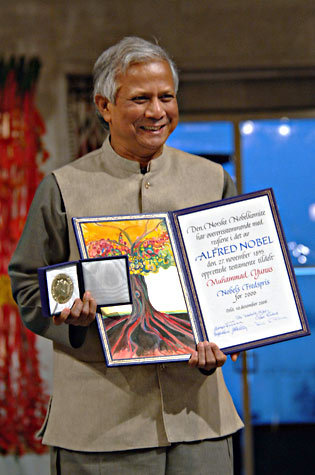
  • 1973-1975 - Interactive laser discs and the first floppy disk drive make their debut. The first cell phone call is made at Motorola. One of the first commercial PCs, the Altair 8800, is shipped as a mail-order kit for $397. Paul Allen and Bill Gates write the first computer language program for personal computers; Gates later drops out of Harvard and founds Microsoft with Allen (and the rest, as they say, is history). In 1976, Steve Wozniak designs the first Apple computer and with Steve Jobs co-found Apple Computer. That same year, Muhammad Yunus (right) launches an "action research project" that eventually becomes the Grameen Bank, a groundbreaking social enterprise that nets Yunus the Nobel Prize in 2006.

  • 1980-1982 - Atari becomes the first company to register a copyright for two computer games, "Asteroids" and "Lunar Lander". Iomega, Quantum, SGI, Maxtor, Symantec, Sun, Lotus, Compaq, Norton Utilities, and Adobe, all pioneering computer companies, are founded. IBM introduces the IBM Personal Computer with a starting price of $1,565. The first successful portable computer, the Osborne I (at 25 pounds!), is introduced. Apple is the first PC manufacturer to hit the $1 billion mark for annual sales.
  • 1990-1991 - Tim Berners-Lee at CERN proposes a "hypertext" system, which is the start of the Internet as we know it today. Microsoft releases Windows 3.0 and sells more than 3 million copies in a year. The first search engine, Archie, is written by a team at McGill University in Canada. The National Science foundation opens the Internet to commercial use. Linux is introduced and the World Wide Web is launched to the public. Teach For America, the largest provider of teachers for lower income communities in the U.S., is launched as the result of a senior thesis by Princeton undergraduate student Wendy Kopp.
  • 2001-2003 - Napster reaches over 26 million users in early 2001 (later filing for bankrupcy in 2002 due to record company litigation but too late to stop the digital music era). MacAfee introduces the first handheld virus protection software. Apple introduces the iPod. Early in 2004, Google launches Gmail.
No one likes economic downturns. Few things induce more personal uncertainty and anxiety, and this one in particular may be doubly devastating because it threatens to derail the significant progress that's been made to eradicate world poverty. But for those with a strong constitution, a great idea, and a bit of historical perspective, this may be just the time to start changing the world.

Sunday, June 08, 2008

East Meets West


A few weeks ago, I was in China at the invitation of my friends at the Chinese Executive Leadership Academy, Pudong (CELAP), located in the outskirts of Shanghai, to present a lecture to thirty high-level government officials. I had been given a daunting task: provide key decision makers in the world's fastest growing economy some new ideas on how governments can create "fertile ground" for innovators in industry, communities, and even the public service itself.

Over a memorable afternoon (at least for me!), we wrestled with what innovation is, what motivates innovators to act, and the lessons
that history has to teach us about what works and what doesn't. Before a spirited Q&A session, we talked about the historic role of government in creating innovative societies and some of the best contemporary examples of innovative governments in action around the world. Luckily, I had lots of great ideas to draw on including some groundbreaking work that my friend Geoff Mulgan, now head of the U.K.'s Young Foundation, developed while working as a strategy guru in the Blair government.

Invitations like these are a great way to highlight the Heinz School's long history of breakthrough thinking about innovation and its impact on government, industry, and communities around the world. It also gives me a chance to further develop Heinz-Australia's growing partnerships with high profile organizations, like CELAP, in the "triangle" from the Gulf States to Asia to Australia. My discussions with two of CELAP's key officials (Mr. Jiang and Dr. Bai pictured) will further expand our ability to recruit students, develop executive education offerings, and create stronger ties to one of the world's most fascinating and influential regions.

Tuesday, January 24, 2006

Big Changes in Little Meetings


On the last morning of the IAJE conference, in a little conference room a few floors above the din of thousands still drinking in a myriad of formal sessions, concerts, and impromptu gatherings, leaders of the nascent National Jazz Platform met with a group of influential jazz presenters and educators (e.g., Monterrey Jazz Festival, Berklee College of Music) to elicit more support for initiatives to raise market share for jazz. In contrast to the gloomy, raw weather in the windows outside, the mood in the room was upbeat and warm. And, while there were lots of probing questions and some trepidation on the part of "veterans" who had "heard some of this before", everyone seemed genuinely interested in figuring out how to make it work.

I've been consistently struck by the commitment and urgency voiced to the industry by the likes of Nancy Wilson and Dr. Billy Taylor to innovate, not only to withstand the technological and cultural changes faced by all kinds of music but to "keep jazz alive" for generations to come.
(I was delighted that Dr. Taylor warmly greeted me at his conference booth the day before after spending just a couple days at Wingspread together nearly a year earlier ... gracious and generous). Jazz has its foot in two camps -- the historical / traditional "art form" camp staked out by the likes of classical music and the contemporary / experimental camp that is firmly owned in mindshare by rap and hip-hop. Like any first year b-schooler will tell you, the "middle" is tenuous place to be in any industry because it's easy to get overwhelmed by the giants and cut off at the knees by upstarts.

The annals of business history are littered with meaningless meetings interspersed with a few watershed events, usually in or set-up by the kind of intimate session that characterized this morning's get-together. I hope that someday we can look back on a meeting held in a sterile hotel conference room on a raw New York City Saturday morning and marvel at all that followed.

Saturday, January 14, 2006

In The Presence of Giants (and Midgets)

Last night at the annual conference of the International Alliance of Jazz Educators, the National Endowment for the Arts (NEA) announced its '06 class of NEA Jazz Masters. Among those honored included the likes of Tony Bennett and Chick Corea.

At the end of the evening, conductors of the two big bands that provided most of the evening's entertainment invited any NEA Jazz Master in the audience to come up on stage and play along. While hearing legends like Latin jazz king Paquito D'Rivera was a real treat and the level of excellence and creativity borne from decades of practice and performance was obvious, I thought that a 10-year old trumpet player that snuck up on stage and was given a shot at the mic stole the show. Not only did he play great but it was clear that he would have been happy to play all night long ... one of the bandleaders literally took the instrument out of his hands to give the rest of the masters some minutes!

As the two bands played with a host of masters (there were probably 40+ musicians on stage by the end of the night), I turned to Marty Ashby, Executive Producer of MCG Jazz (an Accelerator venture), and pointed out how the actions on stage represented much of what companies around the world will need more of the in the future -- creativity, improvisation, teamwork, individual mastery, respected leadership, joy, passion, enthusiasm ...

Hmm, now if you could just bottle that up and get it out to the masses ...

Tuesday, January 03, 2006

What Is "It"?

Innovation (n.): "The intersection of invention and insight, leading to the creation of social and economic value."


You can't pick up a business magazine without reading about it. Or listen to an executive interview nowadays without hearing about it. What is "it"? Innovation. Yeah, you want your organization to reflect "it". You want your products to embody "it". Heck, you hope you have "it". I know I've been talking a lot about "it" lately and hope that the Accelerator and our ventures have "it". But here's the $64,000 question (and believe me, winning $64K was a big deal a generation ago): What, exactly, is innovation? What does it look (smell, taste, feel ...) like? Can it be developed to grow in people, organizations, or even communities over time like a muscle can be trained to get stronger and more useful? Is it like air or can people/ organizations/ communities live without it for a long time?

I don't have all the answers but I do know that I've been spending some quality time trying to wrap my head around the essence of innovation. My gut tells me that our organization, our ventures, and for sure our community will need bigger and bigger doses of it and now my head is demanding that I get closer to figuring out what "innovation" means in the context of our efforts to support a more entrepreneurial, vibrant, and impactful social sector. If there's one theme that's come through loud and clear so far, its that there can't be an innovation without engagement with the real world to test if a great idea really works, that is, has a tangible impact that is readily apparent.

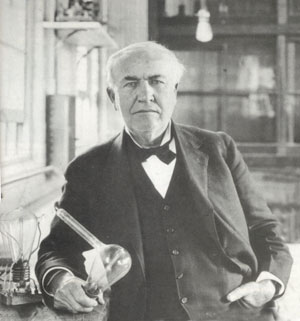
After all, Edison's work with the light bulb would have been an
interesting science experiment if it hadn't been tested in the real world and a host of other, supporting, innovations and the development of standard practices hadn't followed. And, even though Edison was recognized as the originator of the innovation, he didn't control its on-going development. For example, his use of direct current later lost out to the alternating-current system developed by the American inventors Nikola Tesla and George Westinghouse.

Looks like I've got my work cut out for me ...


Wednesday, October 12, 2005

So Many Books, So Little Time

As far back as I can remember, I've operated in a gray area of acceptable societal norms: the jock who can't keep his nose out of a book. Ahh, books! I've always been fascinated by every aspect of the industry -- how do authors get their brilliant ideas on paper in a coherent way, how are the army of supporters (like editors, photographers, cover artists) coordinated, how are books manufactured and marketed, how cool is it to get royalty checks in the mail?

But the whole idea of becoming an "author" is both daunting and frustrating. How do the seemingly limitless number of book ideas rummaging around my head and written down on sticky notes and the backs of napkins jive with a long-cycle, high overhead industry? I recently ran across a model that may provide an answer and at the same time make the whole book publishing industry increasingly irrelevant.

More Space is a book project that:


"...presents nine current business bloggers writing in their own unique styles. Each author challenges the premise that places of business can only be cold and uninspiring. By sharing their own experiences they offer up ways for you to re-ignite passion and enthusiasm in your work."


Can't diss the premise and topic for sure but what I really like about the project is the intent to offer a variety of formats (pdf, html, mp3, hardcover), license the works using Creative Commons, provide an initial run of the hardcover version with stuff you can't get in the free versions, and find a "business model" that fits consumer needs and pays for itself including compensation for the authors (prominent bloggers in this case).

Hmm, now where did I put all of those napkins and sticky notes ...?